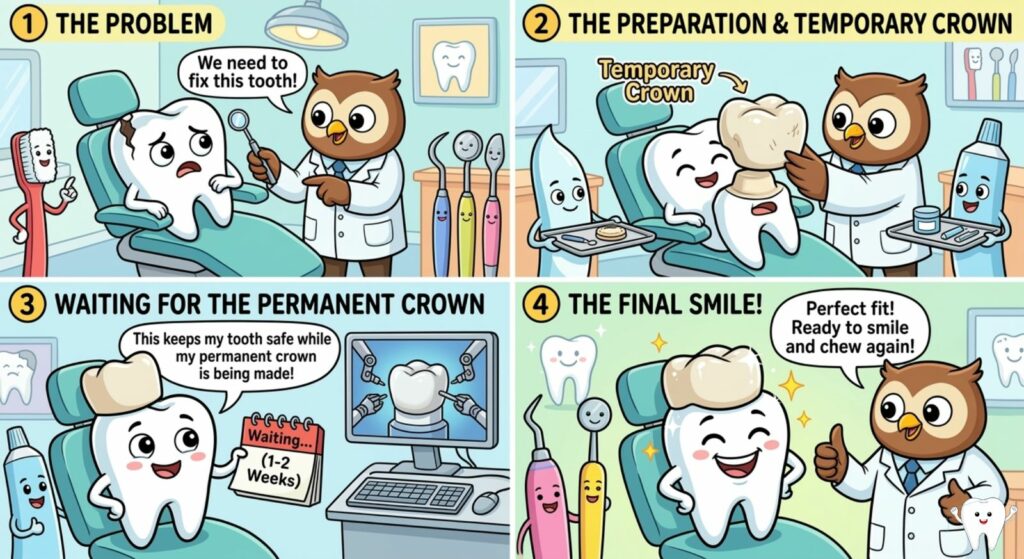
When a dentist prepares a tooth for a crown, the job is not finished the same day. The final crown usually takes one to two weeks to be made in a dental laboratory. During this time, the prepared tooth needs protection. That is where a temporary crown comes in.
Many patients underestimate the role of a temporary crown. They assume it is just a placeholder that does not require attention. In reality, it plays an important role in protecting the tooth, maintaining appearance, and preventing complications before the permanent crown is fitted.
Let’s break down why temporary crowns are used, what problems they prevent, and how they support the success of your final crown.
The Problem: A Prepared Tooth Is Vulnerable
When a tooth is prepared for a crown, the dentist removes a portion of enamel and reshapes the tooth. This creates space for the permanent crown to fit correctly.
However, this preparation leaves the tooth in a fragile state.
Without protection, several issues can occur:
1. Tooth sensitivity
The inner layers of the tooth become more exposed after preparation. Patients often experience sensitivity to hot, cold, or pressure.
2. Tooth movement
Teeth naturally shift over time. If the prepared tooth is left uncovered, nearby teeth may move slightly into the space. Even a small shift can prevent the permanent crown from fitting properly.
3. Gum irritation
The gum around the prepared tooth can become irritated if food or bacteria collect in the area.
4. Risk of damage
A prepared tooth has less structure and can crack or chip more easily.
If any of these issues occur, the dentist may need to adjust the final crown or redo part of the procedure. This increases both time and cost for the patient.
The impact: Small Gaps Can Turn Into Bigger Problems
Some patients think a temporary crown is optional. Others accidentally dislodge it and delay returning to the dentist.
Unfortunately, ignoring a temporary crown can create real problems.
Tooth movement can affect crown fit
A study published in the Journal of Prosthetic Dentistry found that minor tooth movement can occur within days when a prepared tooth is left uncovered. Even a shift of less than 0.5 mm can affect how the permanent crown sits on the tooth.
This may require additional adjustments or remaking the crown.
Sensitivity can increase
The American Dental Association (ADA) reports that exposed dentin can increase tooth sensitivity because the protective enamel layer has been reduced during preparation.
Temporary crowns help reduce this sensitivity by covering the exposed tooth.
Gum health can be affected
Temporary crowns also help guide gum tissue around the prepared tooth. Without that support, the gum can swell or change shape, which may make it harder for the permanent crown to fit correctly.
Real patient example
A case report from a prosthodontic clinic in the UK examined a patient who lost a temporary crown three days after preparation and waited over a week before returning.
During that time:
The prepared tooth became sensitive
The adjacent tooth shifted slightly
The gum tissue became inflamed
As a result, the dental team had to reprepare the tooth and adjust the final crown. This added an extra appointment and increased treatment time.
Situations like this show why temporary crowns should not be ignored.
The Solution: How Temporary Crowns Protect Your Tooth
A temporary crown acts as a short-term shield for the prepared tooth while the permanent crown is being made.
Although it is not designed to last long-term, it performs several important functions.
1. Protecting the prepared tooth
Temporary crowns cover exposed dentin and reduce sensitivity. This allows patients to eat and drink more comfortably during the waiting period.
2. Maintaining tooth position
By covering the tooth, the temporary crown helps maintain the correct spacing between teeth. This ensures the permanent crown will fit properly when it arrives from the laboratory.
3. Supporting gum shape
Temporary crowns help maintain the natural contour of the gum around the tooth. This supports both the function and appearance of the final crown.
4. Maintaining appearance
For front teeth in particular, a temporary crown helps maintain the patient’s smile while waiting for the permanent restoration.
Materials Used for Temporary Crowns
Temporary crowns are usually made from materials designed for short-term use.
Common materials include:
Acrylic resin
Composite resin
Pre-formed stainless steel shells (in some cases)
These materials are easier to shape and adjust compared to permanent crown materials like porcelain or zirconia.
Because temporary crowns are not designed for long-term durability, dentists typically use temporary cement to attach them. This makes it easier to remove them when the permanent crown is ready.
How Long Do Temporary Crowns Last?
Most temporary crowns are worn for 1 to 3 weeks, depending on how long the dental laboratory needs to fabricate the final crown.
However, in some situations they may be worn longer, such as:
Complex crown cases
Implant crown healing phases
Cosmetic planning cases
Research published in the International Journal of Prosthodontics shows that well-made temporary crowns can function effectively for several weeks if patients follow proper care instructions.
Caring for a Temporary Crown
Patients play an important role in keeping a temporary crown in place.
Dentists usually recommend a few simple precautions.
Avoid sticky foods
Sticky foods like chewing gum or caramel can pull the temporary crown off.
Chew on the opposite side
When possible, chewing on the other side of the mouth can reduce pressure on the temporary crown.
Maintain oral hygiene
Brushing and flossing should continue as normal, but floss should be removed gently by sliding it out rather than lifting it straight up.
Contact your dentist if it comes loose
If the temporary crown falls out, it is best to contact the dental practice quickly. In many cases, the dentist can simply reattach it.
What Happens During the Permanent Crown Appointment?
Once the final crown is ready, the dentist will remove the temporary crown and check the fit of the permanent one.
This appointment usually involves:
Removing the temporary crown
Cleaning the prepared tooth
Checking the fit and bite of the permanent crown
Cementing the crown permanently
If the temporary crown maintained the correct tooth position and gum shape, the final crown typically fits smoothly with minimal adjustments.
Why Temporary Crowns Matter More Than People Think
Temporary crowns may seem like a small step in the crown procedure, but they protect the work already done on the tooth.
They help prevent:
Tooth sensitivity
Tooth movement
Gum irritation
Crown fitting problems
Clinical evidence and real patient cases show that skipping or losing a temporary crown can complicate treatment.
For most patients, the temporary crown simply stays in place until the final crown is ready. When cared for properly, it quietly does its job in the background.
And when the permanent crown is finally fitted, patients benefit from a restoration that fits comfortably and functions as expected.
FAQs for TRICARE Patients
For patients from US military families living in the UK, accessing dental care may come with additional questions about coverage and claims. Below are answers to some common queries.
Do you accept TRICARE?
Yes. We welcome TRICARE patients and US military families.
The Thatch Dental Practice is an official TRICARE Overseas Preferred Provider in the UK, working closely with United Concordia.
Will TRICARE cover all of my treatment?
TRICARE coverage depends on your individual plan and the type of treatment required.
Before starting any treatment, we will clearly explain your options and discuss expected costs so you can make an informed decision.
For covered treatments, claims are submitted directly to TRICARE/United Concordia, and in most cases you do not need to pay us directly.
Can you help with paperwork and claims?
Yes. Our experienced team will take care of the administrative process for you.
We submit claims on your behalf and provide any required clinical notes or documentation. You do not need to complete paperwork or manage claims yourself.
I have toothache — can I be seen urgently?
Yes. If you are experiencing pain or discomfort, please contact us and we will do our best to offer the earliest appropriate appointment.
Email: patient.coordinator@thethatchdental.co.uk
Or use the chatbot on our website for quick assistance.
Do you see children and families?
Yes. We provide dental care for both adults and children and are happy to support families with routine check-ups, preventive care, and ongoing oral health needs.
I’m new to the UK — will the process be complicated?
Not at all. We are experienced in welcoming patients who are new to the UK or newly posted to the area.
Our team will guide you step-by-step and support you throughout, ensuring smooth and timely access to dental care.