Problem: It Starts Quietly—and Most People Miss It
Gum disease doesn’t usually hit with sudden pain. It builds slowly. That’s why many people ignore it until it becomes serious.
You brush daily. You don’t feel anything unusual. So you assume everything is fine.
But here’s the reality: gum disease (also called periodontal disease) is one of the most common oral health problems worldwide. According to the World Health Organization, severe gum disease affects around 19% of adults globally, which is over 1 billion people.
The bigger issue? Most cases start with mild symptoms that are easy to overlook.
If you don’t catch those early signs, the damage can move from your gums to the bone supporting your teeth—and at that point, treatment becomes more complex and costly.
Impact: Small Symptoms Turn Into Bigger Problems
Let’s break down what actually happens.
Gum disease begins with plaque—a sticky layer of bacteria. If it’s not removed properly, it hardens into tartar. This irritates the gums and leads to inflammation.
At first, it’s just gingivitis. Reversible. Manageable.
But if ignored, it progresses into periodontitis. This is where the real damage begins—gum recession, bone loss, and eventually tooth loss.
A long-term study published in the Journal of Clinical Periodontology followed patients over 10 years and found that individuals with untreated gum disease were significantly more likely to lose multiple teeth compared to those who received early treatment.
Even more concerning, gum disease doesn’t just stay in your mouth.
Research from the American Academy of Periodontology shows links between gum disease and systemic conditions like:
- Heart disease
- Diabetes
- Respiratory issues
So when you ignore bleeding gums, you’re not just risking your smile—you may be affecting your overall health.
Solution: Recognize the Signs Early and Act Fast
Here’s the part most people need: clarity.
What exactly should you look for?
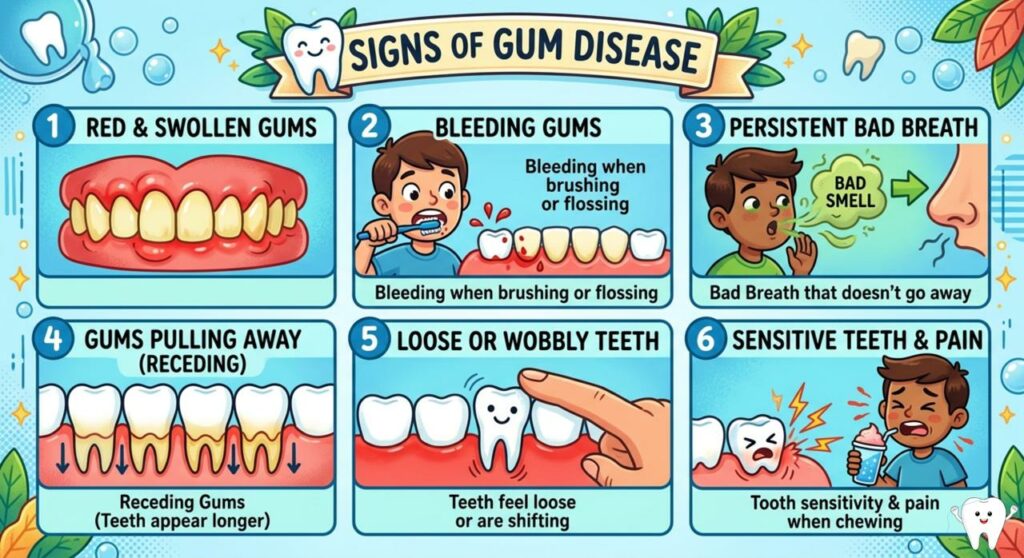
Below are the most common signs of gum disease—explained in a way that helps you identify them early.
1. Bleeding Gums
If your gums bleed when you brush or floss, that’s not normal.
Many people think, “I brushed too hard.” But in most cases, bleeding is a sign of inflammation caused by plaque buildup.
A clinical study in the Journal of Periodontal Research showed that over 70% of patients with early-stage gum disease reported bleeding gums as their first symptom.
What it means:
Your gums are reacting to bacteria. This is usually the earliest warning sign.
2. Red, Swollen, or Tender Gums
Healthy gums are firm and pale pink.
If yours look red, puffy, or feel sore, it’s a sign that your body is fighting an infection.
What it means:
Inflammation has already started. This stage is still reversible with proper care.
3. Persistent Bad Breath
Bad breath that doesn’t go away—even after brushing—can be a red flag.
The bacteria responsible for gum disease release toxins that create an unpleasant smell.
A case study from a dental university clinic found that patients with chronic bad breath were frequently diagnosed with moderate gum disease after examination.
What it means:
The problem isn’t just on the surface. It’s happening below the gumline.
4. Gum Recession (Gums Pulling Away)
Do your teeth look longer than before?
That’s usually not your imagination. It’s gum recession.
As gum disease progresses, the gums start pulling away from the teeth, exposing more of the tooth or even the root.
What it means:
You’re moving beyond early-stage gum disease. Structural damage may already be happening.
5. Sensitivity to Hot and Cold
If you feel sudden sensitivity while drinking tea or cold water, it could be due to exposed tooth roots.
When gums recede, they stop protecting sensitive areas of your teeth.
What it means:
This is often linked to gum recession and requires attention.
6. Loose or Shifting Teeth
Teeth should feel stable.
If they start moving slightly or your bite feels different, it’s a serious sign.
A long-term periodontal case study found that tooth mobility is strongly associated with advanced gum disease and underlying bone loss.
What it means:
The supporting structures of your teeth are weakening.
7. Pus Between Teeth and Gums
This is one of the clearest signs of infection.
If you notice pus or a bad taste coming from your gums, it indicates an active bacterial infection.
What it means:
Immediate dental care is required.
8. Pain While Chewing
Gum disease doesn’t always cause constant pain, but discomfort while chewing can be a warning.
What it means:
Inflammation or infection may be affecting deeper tissues.
Real Case Insight: What Happens When Signs Are Ignored
A published case report in the International Journal of Dentistry followed a 42-year-old patient who initially ignored bleeding gums and mild bad breath.
Within 3 years:
- Gum recession became visible
- Several teeth became loose
- Bone loss was confirmed through X-rays
The patient eventually required:
- Deep cleaning procedures
- Surgical gum treatment
- Tooth extraction in severe areas
The key takeaway?
The earliest signs were present—but ignored.
What You Should Do Next
If you notice even one of these signs, don’t wait.
Here’s a simple action plan:
1. Improve daily oral hygiene
- Brush twice a day
- Floss daily
- Use an antibacterial mouthwash
2. Schedule a dental check-up
A professional cleaning can remove tartar that brushing can’t.
3. Monitor changes
Pay attention to bleeding, swelling, or sensitivity over time.
4. Don’t delay treatment
Early-stage gum disease is reversible. Advanced stages are not.
If You’re a TRICARE Patient: What to Expect
If you’re part of a US military family or covered under TRICARE, getting dental care for gum disease or routine check-ups can feel confusing at first—especially if you’re based overseas. Here’s how the process typically works:
Do you accept TRICARE?
Yes. We welcome TRICARE patients and US military families.
The Thatch Dental Practice is an official TRICARE Overseas Preferred Provider in the UK, working closely with United Concordia.
Will TRICARE cover all of my treatment?
Coverage depends on your individual plan and the type of treatment required. Before starting any treatment, your options and expected costs are explained clearly so you can make an informed decision.
For covered treatments, claims are usually submitted directly to TRICARE/United Concordia, and in most cases, you don’t need to pay upfront.
Can you help with paperwork and claims?
Yes. The dental team typically handles the administrative process, including submitting claims and providing clinical documentation. This means you don’t have to manage the paperwork yourself.
I have toothache — can I be seen urgently?
Yes. If you’re experiencing pain or discomfort, you can contact the practice to arrange the earliest suitable appointment.
Do you see children and families?
Yes. Care is available for both adults and children, including routine check-ups, preventive care, and ongoing oral health support.
I’m new to the UK — will the process be complicated?
Not at all. Practices experienced with TRICARE patients usually guide you step by step, making the process simple and smooth.
Final Thought
Gum disease doesn’t usually shout. It whispers.
A little bleeding. Slight swelling. Mild bad breath.
Easy to ignore. But costly if you do.
The good news is simple:
If you catch it early, you can stop it.