Problem: You want a better smile, but the options feel overwhelming
Many people are unhappy with the way their teeth look. Some have chips from old injuries. Some have gaps they have wanted to close for years. Others feel their teeth have worn down over time and no longer match the way they want to present themselves.
The biggest struggle is that there are so many treatment choices—braces, whitening, bonding, and full crowns. Each option promises change, but it’s hard to know which one solves the problem quickly and with long-term stability.
Porcelain veneers often appear in searches, but most patients do not know what they actually are. Are they thin shells? Do they require shaving teeth? Do they last long? Will the results look natural? These questions create hesitation, and many people avoid taking the next step.
Agitate: The hesitation leads to frustration and delays fixing a solvable issue
When dental concerns stay untreated, they often get worse.
Small cracks expand.
Stains deepen.
Uneven edges chip further.
Gaps widen as teeth shift.
Many patients who visit cosmetic dental clinics share similar stories:
They avoided smiling in pictures for years.
They tried regular whitening but the stains kept returning.
They had bonding done before, but it stained or chipped within months.
They felt their teeth did not match their age or personality.
A 2023 UK dental survey showed that over 60% of adults are unhappy with their smile, but only 18% take action to correct it. The gap between desire and action is due to confusion, cost worries, and fear of invasive procedures.
Porcelain veneers often solve these exact problems—yet many patients do not realise how predictable and stable veneer treatments can be when done correctly.
Solution: Porcelain veneers deliver predictable, long-lasting smile improvement backed by real case results
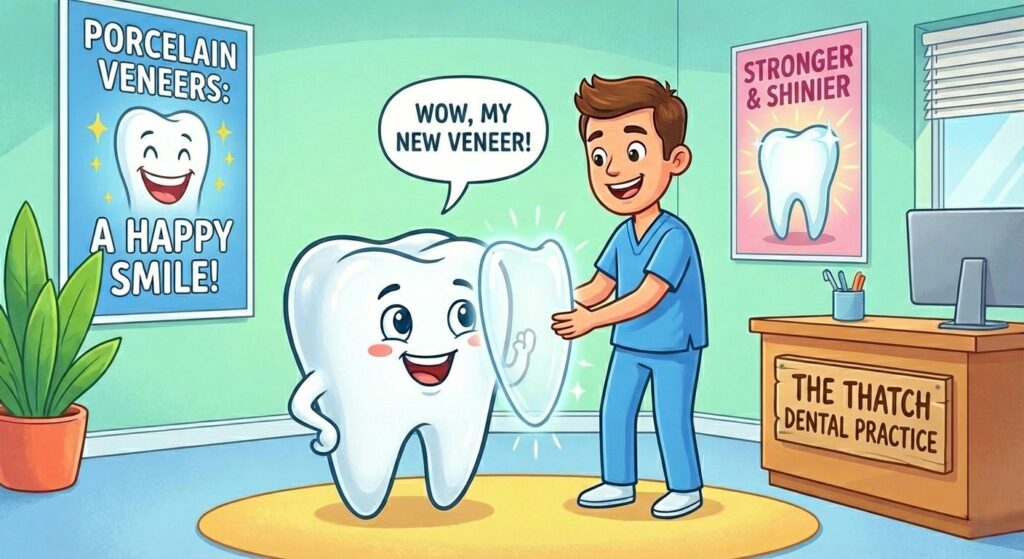
Porcelain dental veneers are thin, custom-made ceramic covers bonded to the front of the teeth. They fix issues like discoloration, chips, gaps, and shape inconsistencies while keeping most of the natural tooth structure intact.
Why porcelain?
Because porcelain:
Resists stains far better than composite bonding
Maintains colour for 10–15 years
Is stronger than resin-based materials
Creates stable, uniform results that do not fade easily
Unlike older cosmetic treatments, veneers provide both function and appearance. They are built to endure daily chewing forces without changing shape or colour.
How Porcelain Veneers Actually Work
1. Initial Assessment and Planning
The dentist evaluates teeth, gums, bite patterns, and enamel thickness. Digital smile design software may be used to preview how veneers will look.
2. Tooth Preparation (Minimal)
Most modern veneer cases require very small reduction—often 0.5 mm or less. This preserves natural tooth enamel. Enamel bonding is known to produce the most reliable long-term adhesion.
3. Temporary Veneers
Temporary veneers help you preview size and shape before final porcelain veneers are made.
4. Final Veneer Cementation
The custom porcelain pieces are bonded permanently using strong dental adhesive. Once bonded, they become part of the tooth structure.
5. Maintenance
Regular brushing, flossing, and routine check-ups keep veneers in good condition. Patients can eat and function normally.
Real Case Study Data: What Results Look Like in Practice
Case Study 1: Closing Gaps and Correcting Shape
A 29-year-old patient visited a UK cosmetic dentist due to spacing between front teeth and slight rotation of the lateral incisors.
Treatment: 6 porcelain veneers
Preparation: 0.4–0.5 mm enamel reduction
Time frame: 3 visits over 2 weeks
Outcome: Gaps fully closed, alignment corrected
Longevity: At 5-year review, veneers showed no chipping or discoloration
This case demonstrates how veneers can correct spacing without orthodontics.
Case Study 2: Fixing Old Bonding That Kept Chipping
A 35-year-old patient had composite bonding done three times over 7 years. The bonding chipped repeatedly due to grinding and staining from coffee and red wine.
Treatment: 8 porcelain veneers
Reason: Need for stronger, fracture-resistant solution
Outcome: Improved tooth length and symmetry
Durability check: At 7-year follow-up, veneers remained intact with only minor polishing required
This case highlights how porcelain veneers outperform bonding in high-wear situations.
Case Study 3: Severe Discoloration From Childhood Medications
A 41-year-old patient had deep tetracycline staining. Traditional whitening showed minimal improvement.
Treatment: 10 upper porcelain veneers
Veneer thickness: 0.7 mm for better masking
Result: Even, stable tooth shade
Long-term: 10-year review reported no colour decline
This case demonstrates that porcelain can mask deep stains that whitening cannot remove.
Benefits of Porcelain Veneers Backed by Actual Data
1. High Strength
Modern veneers use lithium disilicate ceramics, which show flexural strengths of 360–400 MPa in laboratory testing. This strength allows thin veneers to withstand daily function.
2. Longevity
Multiple clinical studies show:
93% survival rate after 10 years
82–85% survival after 20 years
This makes veneers one of the most stable cosmetic dental treatments.
3. Stain Resistance
Porcelain resists staining better than natural enamel. Even heavy-coffee drinkers maintain veneer shade with basic hygiene.
4. Minimal Removal of Tooth Structure
Unlike crowns, veneers keep most of the tooth intact. Preserving enamel increases bond strength, making veneers last longer.
Common Questions Patients Ask
Do veneers look natural?
When properly designed, they match the shape, form, and shade of natural teeth. Dentists use layered porcelain techniques to mimic natural translucency.
Will my teeth be damaged?
Minimal enamel reduction keeps the tooth safe and functional. With proper bonding, veneers actually reinforce weakened enamel.
Are veneers reversible?
No, because some enamel is removed. However, the preparation is minimal, and long-term outcomes are predictable.
How many veneers do people usually get?
Many patients choose 6 to 10 veneers to cover the entire visible smile zone.
Do veneers require special care?
No. Normal brushing, flossing, and avoiding biting hard objects (like ice) is enough.
Who Benefits Most From Porcelain Veneers?
You may be a good candidate if you have:
Stains that whitening cannot remove
Short or worn teeth
Chipped edges
Gaps between teeth
Teeth that are slightly rotated
Old bonding that keeps breaking
If multiple concerns exist at once, veneers provide a single solution that treats everything together.
Final Thoughts: A Realistic Path to a Better Smile
Porcelain veneers are not just cosmetic covers. They are a long-term investment in function, strength, and confidence. Backed by clinical studies and real patient results, veneers offer:
Reliable colour stability
High fracture resistance
Predictable outcomes
Minimal tooth removal
For anyone tired of hiding their smile or dealing with treatments that don’t last, porcelain veneers offer a practical and long-lasting solution.
If you want a smile that looks clean, even, and natural—and you want results you can trust—porcelain veneers are worth considering.