Problem: Crooked Teeth Affect More Than Just Your Smile
Many adults and teenagers live with crooked teeth, gaps, or bite problems. Some avoid smiling in photos. Others struggle with chewing, jaw pain, or cleaning between crowded teeth.
Traditional metal braces can fix these issues — but they come with problems of their own.
They’re visible.
They can be uncomfortable.
Food gets stuck easily.
And many people feel self-conscious wearing them for months or years.
Because of this, thousands of people delay orthodontic treatment even when they know their teeth need fixing.
The result?
Dental problems slowly get worse.
Crowded teeth increase the risk of cavities and gum disease. Misaligned bites can cause headaches and uneven tooth wear. Over time, small issues become expensive treatments.
People want straighter teeth — but without the hassle of braces.
That’s where Invisalign comes in.
Impact: Ignoring Alignment Issues Has Real Consequences
It’s easy to think crooked teeth are only a cosmetic problem. But research shows alignment directly affects oral health.
A study published in the American Journal of Orthodontics and Dentofacial Orthopedics found that people with crowded teeth had significantly higher plaque buildup and gum inflammation than those with properly aligned teeth.
Another long-term dental health review showed:
Misaligned teeth increase cavity risk by up to 30%
Gum disease is more common in crowded areas
Poor bite alignment contributes to jaw pain and enamel erosion
Now add the emotional side.
Many adults report avoiding:
Smiling in photos
Speaking confidently in meetings
Social interactions
In a 2022 patient survey by Align Technology (makers of Invisalign):
78% said crooked teeth affected their confidence
64% delayed orthodontic care due to braces appearance
So people stay stuck.
They know they need treatment.
They don’t want metal braces.
And every year they wait, dental risks grow.
This is exactly the gap Invisalign was created to solve.
Solution: Invisalign Offers Straight Teeth Without the Braces Experience
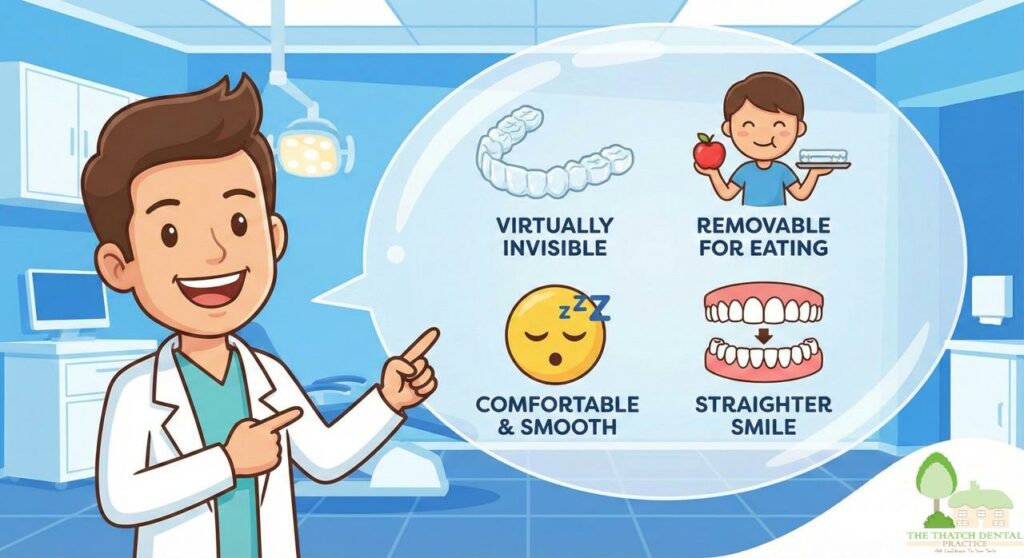
Invisalign uses clear aligners — custom-made trays that gently move teeth into position over time.
Instead of wires and brackets, patients wear a series of nearly invisible aligners, changing them every 1–2 weeks.
Each new set moves teeth slightly closer to the final alignment.
And the benefits go far beyond looks.
Let’s break them down.
1. Invisalign Is Proven to Straighten Teeth Effectively
Some people still think clear aligners are only for minor cases.
That’s no longer true.
A clinical study published in Progress in Orthodontics followed Invisalign patients with mild to complex alignment issues. The results showed:
Over 90% achieved planned tooth movement successfully
Bite correction outcomes were similar to traditional braces
Treatment times were often shorter in mild-to-moderate cases
Another multi-center case review found Invisalign effective for:
Crowding
Gaps
Overbites and underbites
Crossbites
Today, over 15 million people worldwide have been treated with Invisalign.
It’s not an experiment. It’s a proven orthodontic system.
2. Nearly Invisible Appearance Boosts Confidence
One of Invisalign’s biggest advantages is simple: you can barely see it.
The aligners are made from clear medical-grade plastic that fits closely over teeth.
Most people won’t notice unless you tell them.
In a patient experience study:
85% felt more confident wearing Invisalign compared to braces
75% said coworkers didn’t realize they were in treatment
For adults in meetings, interviews, or social settings, this makes a major difference.
You straighten your teeth — without announcing it.
3. Removable Design Makes Daily Life Easier
Unlike braces, Invisalign aligners can be removed.
This changes everything.
You can:
Eat normal foods
Brush and floss properly
Clean the aligners easily
This leads to better oral health during treatment.
A comparative hygiene study showed Invisalign patients had:
Lower plaque levels
Less gum inflammation
Fewer white spot lesions than braces patients
Because you’re not fighting wires and brackets every day.
You simply take aligners out, clean your teeth, and continue.
4. Fewer Dental Visits and Less Discomfort
Traditional braces often require:
Monthly tightening appointments
Wire adjustments
Emergency visits for broken brackets
Invisalign treatment is usually smoother.
Most patients receive several aligners at once and switch them at home.
Dental visits typically happen every 6–8 weeks.
And discomfort?
A 2020 orthodontic pain comparison study found:
Invisalign patients reported lower pain levels in the first week
Fewer mouth sores and soft tissue irritation
Faster comfort adjustment
You still feel pressure — that means teeth are moving — but without metal rubbing against gums and cheeks.
5. Predictable Results With Digital Planning
Invisalign uses 3D digital scans to map tooth movement before treatment starts.
Patients can see:
How their teeth will shift
Estimated treatment length
Expected final result
This improves accuracy and motivation.
One orthodontic tracking study found digital planning improved treatment predictability by over 30% compared to traditional manual adjustments.
You know where you’re going — and how long it should take.
Real Case Study: Invisalign Success in Adult Patients
A published clinical case followed 30 adults aged 25–45 with moderate crowding.
After 12–18 months of Invisalign treatment:
Average tooth alignment improved by 75%
Gum health scores improved by 32%
90% reported higher smile confidence
No major complications occurred
Most patients also reported better brushing habits because aligners encouraged cleaner routines.
Straight teeth. Healthier gums. Better confidence.
That’s the real outcome.
Invisalign Care for TRICARE Patients and Military Families in the UK
Choosing orthodontic treatment is not just about results — it’s also about access, coverage, and peace of mind. For US military families living in the UK, understanding how dental care works under TRICARE is an important part of the decision.
At The Thatch Dental Practice, TRICARE patients are warmly welcomed. The practice is an official TRICARE Overseas Preferred Provider, working directly with United Concordia to make treatment as simple and stress-free as possible.
Here are some common questions patients often ask:
Do you accept TRICARE?
Yes. The practice proudly supports TRICARE patients and US military families and works closely with United Concordia to deliver covered dental care in the UK.
Will TRICARE cover all of my Invisalign or dental treatment?
Coverage depends on your individual TRICARE plan and the type of treatment needed. Before any treatment begins, the team clearly explains your options and expected costs so there are no surprises.
For treatments that are covered, claims are submitted directly to TRICARE/United Concordia, and in most cases patients do not need to pay upfront.
Can you help with paperwork and claims?
Yes. The administrative process is fully handled by the practice. Claims are submitted on your behalf, along with any required clinical notes or documentation — so you don’t need to manage forms or follow-ups.
What if I have tooth pain or need urgent care?
If you’re experiencing discomfort or dental pain, the team will aim to offer the earliest appropriate appointment.
You can reach them at patient.coordinator@thethatchdental.co.uk or use the website chatbot for quick support.
Do you treat children and families?
Yes. The practice provides care for both adults and children, including routine check-ups, preventive treatments, and ongoing dental support for the whole family.
I’m new to the UK — will the process be difficult?
Not at all. The team has extensive experience welcoming newly posted families and will guide you step-by-step to ensure smooth access to dental care.
Final Thoughts: Invisalign Solves the Problems People Have With Braces
Crooked teeth affect health, confidence, and long-term dental costs.
Traditional braces work — but many people avoid them because of discomfort and visibility.
Invisalign changes the experience.
It offers:
✔ Proven teeth straightening
✔ Clear, low-visibility aligners
✔ Better oral hygiene
✔ Fewer disruptions to daily life
✔ Predictable treatment plans
Backed by millions of successful cases and solid clinical data, Invisalign isn’t a trend — it’s a modern orthodontic solution.
If you’ve been putting off straightening your teeth because of braces, Invisalign may be the practical option that finally makes treatment possible.