
Tooth nerve pain can appear suddenly and become difficult to ignore. One minute you are fine, and the next you are dealing with a sharp, throbbing or shooting pain that makes it difficult to sleep, eat or concentrate.
When this happens, many people search for “how to stop tooth nerve pain instantly without dentist” because they want relief right away.
The important thing to understand is that there is no reliable home remedy that can permanently switch off tooth nerve pain. You may be able to reduce the pain temporarily with appropriate self-care, but if the nerve is inflamed, infected or exposed because of decay or damage, the underlying problem usually needs dental treatment.
So, what can you do right now?
Problem: Why Does Tooth Nerve Pain Hurt So Much?
Inside every tooth is a soft area called the pulp. It contains nerves and blood vessels. When decay, a crack, trauma or another dental problem gets close to this area, the nerve can become irritated or inflamed.
This can cause different types of pain.
You may notice:
- A sharp pain when drinking something cold
- Severe pain with hot drinks
- A throbbing sensation
- Pain that starts without an obvious trigger
- Pain that gets worse when lying down
- Pain when biting or chewing
- Pain that spreads towards the jaw, ear or surrounding teeth
- Sensitivity that continues after the hot or cold food has gone
Tooth nerve pain is not always caused by an infection. Tooth decay, a cracked tooth, a damaged filling, gum problems and dental trauma can all cause toothache.
That is why simply treating the pain does not necessarily fix the tooth.
Impact: Why Ignoring Nerve Pain Can Make Things Worse
The biggest mistake is assuming that because the pain disappears, the tooth has healed.
It has not necessarily healed.
Sometimes toothache comes and goes. You might have intense pain at night, take a painkiller and wake up the next morning feeling much better. That can create the impression that the problem has disappeared.
But the original cause may still be present.
For example, if deep tooth decay has reached the pulp, the nerve may become increasingly inflamed. If bacteria have entered the tooth and an infection develops, an abscess can form.
According to the NHS, a dental abscess is a collection of pus caused by infection and does not go away on its own. It requires urgent dental treatment.
This is why trying to permanently manage severe tooth nerve pain at home can delay treatment.
A realistic clinical example
Imagine someone develops severe sensitivity in a lower molar. Cold water produces a sharp pain that lasts several seconds. They begin avoiding cold drinks and use painkillers when the pain becomes uncomfortable.
For a few days, the symptoms seem manageable.
Then the tooth starts hurting without food or drink. At night, the pain becomes more noticeable and eventually affects sleep.
This is a typical pattern in which the symptoms have changed rather than disappeared. The exact diagnosis would require a dental examination, and possibly tests or an X-ray.
The lesson is simple: temporary pain relief is not the same as treating the cause.
Solution: What Can You Do for Tooth Nerve Pain at Home?
If you cannot see a dentist immediately, there are several measures that may help you manage the pain temporarily.
1. Consider appropriate pain relief
For adults, commonly used painkillers such as paracetamol or ibuprofen can help with toothache when they are suitable for the individual. NHS guidance specifically lists both as options for easing toothache.
Always follow the instructions on the packet or leaflet and do not exceed the recommended dose.
Ibuprofen is an anti-inflammatory painkiller, but it is not suitable for everyone. For example, some people with certain stomach, kidney, heart or other health problems may need to avoid it.
If you are unsure which medicine is appropriate for you, ask a pharmacist.
Taking more tablets does not make tooth nerve pain disappear faster and can be dangerous.
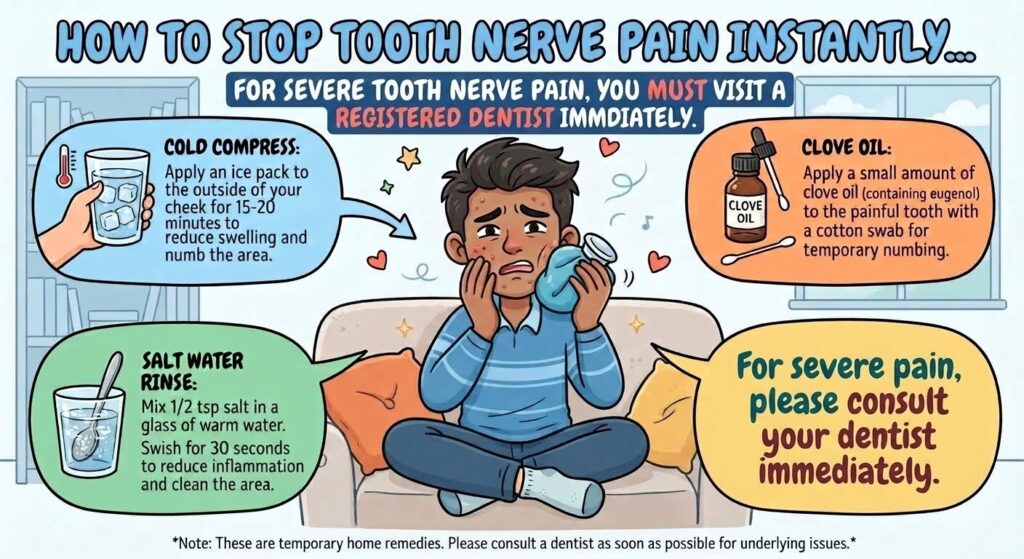
2. Rinse with warm salt water
A simple salt-water rinse can help keep the mouth clean and may provide temporary comfort.
The NHS recommends dissolving half a teaspoon of salt in a glass of warm water, rinsing the mouth and spitting it out rather than swallowing it.
Do not give salt-water rinses to young children who may swallow the solution.
3. Avoid very hot and cold foods
If the tooth nerve is irritated, temperature changes can trigger pain.
For the moment, avoid:
- Very cold drinks
- Very hot food
- Sugary foods
- Hard foods
- Chewing directly on the painful tooth
Instead, choose softer foods and chew on the opposite side of your mouth.
4. Keep the area clean
It may be tempting to stop brushing around a painful tooth.
Don’t.
Continue brushing gently with a soft toothbrush. Keeping your mouth clean can help prevent additional plaque and food debris from irritating the area.
However, if flossing directly around the painful tooth causes significant discomfort, avoid forcing the floss into the sore area.
5. Try a cold compress if there is swelling
A cold compress placed against the outside of the cheek may help reduce discomfort and swelling temporarily.
Do not put ice directly against your skin. Wrap it in a towel and use it for short periods.
Remember that reducing swelling does not treat an underlying dental infection.
Can You Stop Tooth Nerve Pain Instantly Without a Dentist?
You may be able to reduce the pain quickly, but there is an important difference between pain control and treatment.
If the nerve is irritated because of a minor sensitivity problem, changing your diet and using appropriate desensitising products may help.
But if the nerve is severely inflamed, the tooth is cracked, decay has reached the pulp, or there is an abscess, home remedies cannot repair the damaged tooth.
Depending on the diagnosis, treatment may involve a filling, root canal treatment, drainage of an abscess, or extraction.
NHS guidance states that toothache lasting more than two days should be assessed by a dentist, particularly when pain does not respond to painkillers or occurs with fever, pain when biting, red gums, bad taste or swelling.
When Tooth Nerve Pain Becomes an Emergency
Do not try to manage severe symptoms at home if you develop significant swelling.
Seek urgent dental help if you have severe or persistent dental pain, facial swelling, fever, or symptoms suggesting a dental abscess.
More serious symptoms require immediate medical attention.
Go to A&E or seek emergency help if swelling around the mouth, neck or eye is affecting your ability to breathe, swallow or speak.
These symptoms can indicate that an infection is spreading and should not be treated as ordinary toothache.
Final Thoughts
If you are searching for how to stop tooth nerve pain instantly without dentist, the safest answer is to focus on temporary pain control rather than trying to permanently treat the tooth yourself.
Painkillers that are appropriate for you, warm salt-water rinses, avoiding temperature triggers, eating soft foods and keeping the area clean can help while you arrange dental care.
But if the pain keeps returning, becomes severe, lasts more than two days, or is accompanied by swelling, fever or a bad taste, don’t keep covering it up with painkillers.
Find out what is causing the pain.
The sooner the cause is identified, the more straightforward treatment may be.