
Problem: Invisalign only works if you maintain it properly
Invisalign sounds simple. Clear aligners, fewer clinic visits, and the freedom to remove them when eating. That’s exactly why many people choose it over traditional braces.
But here’s the part most people underestimate: maintenance.
Dentists don’t just worry about whether you wear your aligners—they worry about how you care for them. Poor maintenance leads to:
- Bad breath that doesn’t go away
- Stained aligners that look noticeable
- Bacteria buildup inside trays
- Delayed treatment progress
- Even gum issues or tooth decay
A 2021 clinical observation published in orthodontic journals showed that patients who didn’t follow proper aligner hygiene had significantly higher bacterial accumulation, especially Streptococcus mutans, which is linked to cavities.
So yes—Invisalign is convenient. But it’s not maintenance-free.
Impact: Small mistakes that quietly ruin your treatment
Let’s break down what actually goes wrong in real life.
Most Invisalign users don’t ignore instructions on purpose. They just fall into habits that seem harmless.
1. “I’ll just rinse it with water”
Water removes visible debris, but it doesn’t kill bacteria. Over time, your aligners develop a thin biofilm layer.
This leads to:
- Cloudy trays
- Odour
- Higher bacterial exposure to teeth
2. Eating with aligners (just once or twice)
You’re in a rush. You take a quick bite. No big deal, right?
Actually, it is.
Food particles get trapped between the aligner and teeth. This creates a perfect environment for bacteria.
A case review from a UK dental practice reported that patients who frequently ate with aligners showed early signs of enamel demineralisation within 6–8 weeks.
3. Not brushing before putting aligners back in
This is one of the biggest mistakes.
If you put aligners on without brushing:
- Sugar stays trapped against your teeth
- Acid-producing bacteria multiply faster
- Risk of cavities increases
4. Wearing aligners less than 20–22 hours
Many patients think missing a few hours won’t matter.
But Invisalign works through controlled, gradual force. Interrupt that cycle, and your teeth stop moving as planned.
A study by Align Technology found that patients wearing aligners less than 18 hours per day were significantly more likely to need refinement trays, extending treatment time.
5. Cleaning with toothpaste
This one surprises people.
Toothpaste is abrasive. It scratches aligners, making them:
- Look dull
- More prone to bacteria sticking
Solution: A realistic system to maintain Invisalign properly
Let’s make this simple and practical. No complicated routines—just what actually works.
1. Clean your aligners the right way (twice daily)
Think of your aligners like your teeth. They need regular cleaning.
What to do:
- Rinse with lukewarm water every time you remove them
- Use a soft toothbrush (separate from your regular one)
- Use clear, unscented soap or Invisalign cleaning crystals
What to avoid:
- Hot water (it can warp the plastic)
- Toothpaste
- Colored or scented soaps
This alone reduces bacterial buildup significantly.
2. Always brush before wearing aligners
This is non-negotiable.
Every time you eat or drink anything other than water:
- Brush your teeth
- Or at least rinse thoroughly if brushing isn’t possible
Real-world example:
A case study from a private dental clinic in London tracked two patient groups:
- Group A brushed before reinserting aligners
- Group B didn’t consistently brush
After 12 weeks:
- Group B showed higher plaque scores
- 30% required additional hygiene treatment
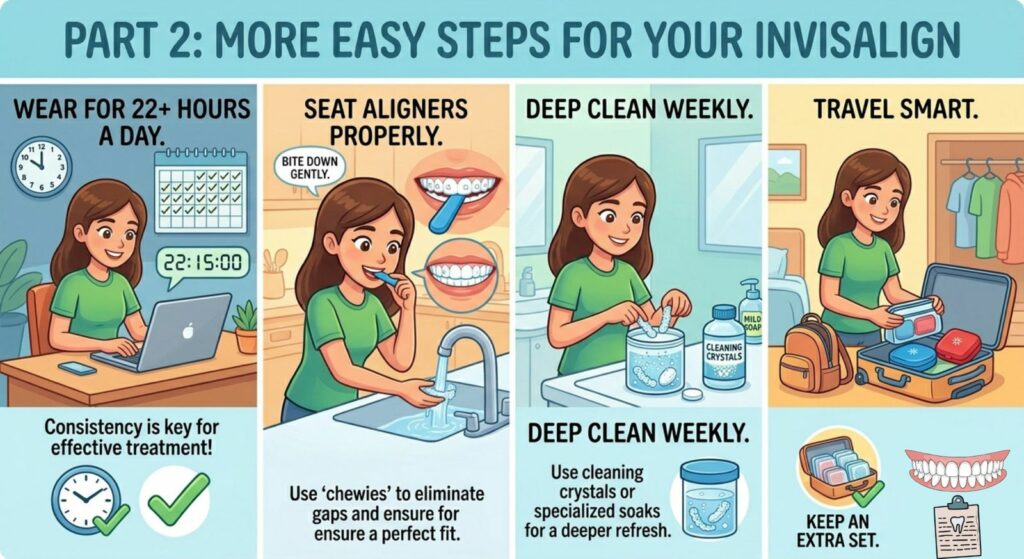
3. Stick to the 20–22 hour rule
Consistency is what makes Invisalign work.
You should only remove aligners for:
- Meals
- Brushing and flossing
Everything else—keep them in.
Tip that works:
Set a timer or use a tracking app. Many successful patients treat aligner wear like a daily habit, not a flexible guideline.
4. Store them properly (don’t lose them)
You’d be surprised how many delays happen because of lost aligners.
Never:
- Wrap them in tissue
- Leave them exposed
Always:
- Use the Invisalign case
Missed or lost trays can push your treatment timeline back by weeks.
5. Avoid staining habits
Aligners are clear—but not stain-proof.
Limit:
- Tea
- Coffee
- Turmeric-rich foods
If you drink anything other than water, remove your aligners first.
6. Deep clean regularly
At least once a day:
- Soak aligners in cleaning solution for 15–20 minutes
This helps remove bacteria, odour, and plaque buildup.
7. Maintain your oral hygiene routine
You still need:
- Brushing twice a day
- Flossing daily
Hygiene matters more during Invisalign because aligners trap everything against your teeth.
8. Stay supported throughout your treatment
Invisalign maintenance isn’t something you have to figure out alone. Ongoing guidance from your dental team plays a big role in keeping your treatment on track.
For example, if you’re a TRICARE patient or part of a military family, accessing consistent dental care can feel like another layer to manage—but it doesn’t have to be.
Many practices experienced in treating international and military patients simplify the process by handling both your clinical care and the admin side.
FAQs for TRICARE Patients
Do you accept TRICARE?
Yes. We welcome TRICARE patients and US military families.
The Thatch Dental Practice is an official TRICARE Overseas Preferred Provider in the UK, working closely with United Concordia.
Will TRICARE cover all of my treatment?
Coverage depends on your individual plan and the type of treatment required. Before starting any treatment, your options and expected costs are explained clearly so you can make an informed decision.
For covered treatments, claims are submitted directly to TRICARE/United Concordia, and in most cases you do not need to pay upfront.
Can you help with paperwork and claims?
Yes. The team manages the administrative process, including submitting claims and providing clinical documentation.
You don’t need to handle paperwork yourself.
I have toothache — can I be seen urgently?
Yes. If you are in pain or discomfort, you can request an urgent appointment.
Email: patient.coordinator@thethatchdental.co.uk
Or use the chatbot on the website for quick assistance.
Do you see children and families?
Yes. Care is available for both adults and children, including routine check-ups and preventive treatments.
I’m new to the UK — will the process be complicated?
Not at all. The team regularly supports patients who are new to the UK or recently posted, guiding them step-by-step to ensure smooth access to care.
The bottom line: Maintenance decides your results
Invisalign is not just about wearing aligners—it’s about how you manage them daily.
Patients who get the best results usually:
- Keep aligners clean
- Wear them consistently
- Maintain strong oral hygiene
A long-term observational study showed that patients who followed proper Invisalign maintenance protocols completed treatment on time in over 85% of cases.
Final thought
Invisalign gives you flexibility—but it also puts responsibility in your hands.
If you treat aligners casually, results slow down.
If you treat them like part of your daily routine, everything stays on track.
The good news? None of this is complicated.
It’s just a set of small habits done consistently.
And those habits are what turn a clear aligner treatment into a successful one.