
How Long Until a Tooth Infection Kills You?
A Toothache Can Feel Small—Until It Isn’t
Most people ignore tooth pain at least once.
You tell yourself it is just sensitivity. Maybe food got stuck. Maybe the swelling will go down tomorrow. You take a painkiller, rinse with salt water, and move on.
But here is the uncomfortable reality: a tooth infection can become dangerous if it spreads beyond the tooth.
The question many people search online is scary but valid: how long until a tooth infection kills you?
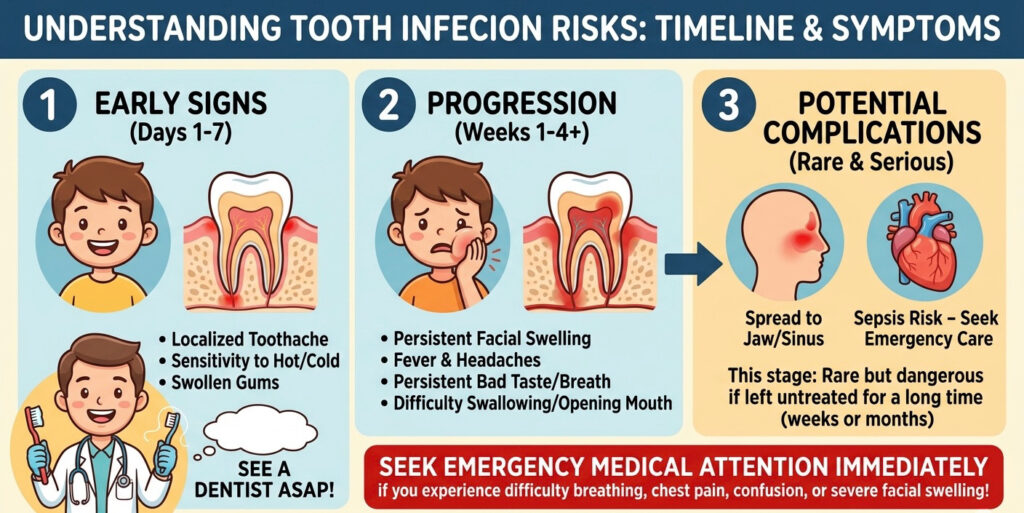
The short answer is this: there is no fixed timeline. For some people, a tooth infection may stay localized for weeks or months. For others, especially if bacteria spread into the bloodstream or deeper tissues, serious complications can happen within days.
That uncertainty is exactly why dental infections should never be ignored.
In this article, we will break down how tooth infections spread, what warning signs matter, how quickly things can turn serious, and what real medical evidence says.
The Problem: Tooth Infections Do Not Always Stay in the Tooth
A tooth infection, also called a dental abscess, happens when bacteria enter the inner part of the tooth called the pulp. This can happen because of untreated cavities, cracked teeth, gum disease, or failed dental work.
At first, the symptoms may seem manageable:
- Throbbing tooth pain
- Swollen gums
- Sensitivity to hot or cold food
- Bad taste in the mouth
- Facial swelling
- Fever in some cases
The problem starts when bacteria stop staying inside the tooth.
Once an infection spreads beyond the root, it can enter nearby tissues in the face, jaw, neck, or even the bloodstream. When that happens, the risk becomes much more serious.
Doctors and dentists are especially concerned about infections spreading to:
- Deep tissues of the face and neck
- Airways, making breathing difficult
- The bloodstream, causing sepsis
- The brain in rare cases
- The heart in high-risk patients
This is why dentists often say that a tooth infection is not “just a tooth problem.”
So, How Long Until a Tooth Infection Becomes Life-Threatening?
There is no exact clock.
Some untreated infections remain painful for months without turning deadly. Others become severe quickly.
In serious cases, dangerous complications can develop within days to weeks if the infection spreads aggressively.
Several factors affect the timeline:
1. Your Immune System
People with diabetes, autoimmune conditions, cancer treatment history, or weakened immunity often face faster spread of infection.
A healthy immune system may slow bacteria down, but it does not guarantee protection.
2. Location of the Infection
Infections in lower molars are sometimes more dangerous because bacteria can spread into spaces near the throat and neck.
If swelling starts affecting swallowing or breathing, it becomes a medical emergency.
3. Whether the Infection Drains
Sometimes an abscess drains naturally, temporarily reducing pain and pressure. Many people mistake this for healing.
But drainage does not mean the infection is gone. Bacteria can still spread underneath.
4. Delayed Treatment
Ignoring symptoms for weeks or months raises risk.
Antibiotics alone may help temporarily, but dentists often need to remove the infection source through root canal treatment or extraction.
The Impact: The Dangerous Part Happens Quietly
One of the biggest problems with tooth infections is that people often wait too long.
Pain may come and go. Swelling may reduce for a few days. Life gets busy.
Then suddenly things change.
What begins as a toothache can turn into:
- Severe facial swelling
- Difficulty swallowing
- Fever and chills
- Trouble opening the mouth
- Neck pain
- Breathing problems
At this stage, doctors worry about serious bacterial spread.
A major complication is sepsis, a life-threatening reaction to infection.
Symptoms of sepsis may include:
- Fast heart rate
- Confusion
- High fever or dangerously low temperature
- Rapid breathing
- Extreme weakness
When infection enters the bloodstream, time matters.
Medical treatment often includes IV antibiotics, hospital care, drainage procedures, and emergency dental treatment.
What Real Case Studies Show
Research shows that while death from dental infections is uncommon today, it still happens—especially when treatment is delayed.
A study published in oral and maxillofacial medical literature reported that deep neck infections caused by dental abscesses can become dangerous rapidly when airway obstruction develops. Hospitalization and surgery were often necessary to control the spread.
Another documented case involved an untreated dental infection progressing into sepsis, requiring emergency intensive care. Doctors found that delay in seeking treatment played a major role in worsening the patient’s condition.
Historically, before antibiotics became common, tooth infections were a leading cause of death. According to historical health estimates, dental infections had mortality rates between 10% and 40% when severe bacterial spread occurred.
Today, deaths are far less common because antibiotics, imaging, emergency care, and dental treatment are more accessible.
Still, “rare” does not mean impossible.
Hospital emergency departments continue to treat severe dental infections every year.
Warning Signs You Should Never Ignore
If you have a tooth infection, certain symptoms mean you should seek urgent dental or medical care immediately.
Call a Dentist Quickly If You Have:
- Persistent tooth pain
- Gum swelling
- Pus near the tooth
- Bad smell or taste in the mouth
- Mild facial swelling
Seek Emergency Help If You Have:
- Trouble breathing
- Difficulty swallowing
- Swelling spreading to the eye, jaw, or neck
- Fever with facial swelling
- Confusion or dizziness
- Severe weakness
These symptoms can signal spreading infection.
Waiting to “see if it gets better” becomes risky at this stage.
The Solution: Early Treatment Changes Everything
The good news is that most dangerous dental infections are preventable.
When treated early, a tooth infection is usually manageable.
Treatment often includes:
Antibiotics
Dentists may prescribe antibiotics if infection has spread or swelling is present.
However, antibiotics alone rarely solve the entire problem.
Root Canal Treatment
If the tooth can be saved, root canal treatment removes infected tissue and seals the tooth.
Tooth Extraction
If the tooth cannot be repaired, removal may stop the infection source.
Drainage
Large abscesses sometimes need drainage to release pressure and bacteria.
The earlier treatment starts, the easier recovery usually becomes.
Can a Tooth Infection Kill You Overnight?
In most cases, No.
Tooth infections usually worsen over time rather than becoming fatal overnight.
But severe complications can escalate faster than many people expect.
Someone may feel “mostly okay” for weeks and then suddenly develop major swelling or fever within a short period.
That unpredictability is why dental professionals recommend not waiting.
Getting Dental Help Quickly: Information for TRICARE Patients
If you are part of a US military family living in the UK, getting fast dental care for a tooth infection may feel stressful—especially if you are unsure about insurance, treatment costs, or how the process works.
At The Thatch Dental Practice, we welcome TRICARE patients and US military families. As an official TRICARE Overseas Preferred Provider in the UK, we work closely with United Concordia to help patients access dental care as smoothly as possible.
Do You Accept TRICARE?
Yes. We regularly support TRICARE patients, including active military families and dependents based in the UK.
Will TRICARE Cover All Treatment?
Coverage depends on your individual TRICARE plan and the type of dental treatment needed.
Before any treatment begins, we clearly explain your options and discuss expected costs so you understand what to expect. For covered treatments, claims are submitted directly to TRICARE/United Concordia, and in many cases patients do not need to pay us directly.
Can You Help With Claims and Paperwork?
Yes. Our experienced team manages the administrative process for you.
We submit claims on your behalf and provide any required clinical notes or supporting documentation. This means you do not have to deal with complicated paperwork yourself.
I Have a Toothache — Can I Be Seen Urgently?
Yes. Tooth infections should not be ignored, especially if pain, swelling, or discomfort is getting worse.
If you need urgent care, contact us and we will do our best to offer the earliest appropriate appointment.
Email: patient.coordinator@thethatchdental.co.uk
You can also use the chatbot on our website for quick assistance.
Do You See Children and Families?
Yes. We provide dental care for both adults and children and are happy to support families with routine check-ups, preventive care, and ongoing oral health needs.
I’m New to the UK — Will the Process Be Complicated?
Not at all.
We regularly support patients who are new to the UK or newly posted to the area. Our team will guide you step-by-step, helping make access to dental care smooth and straightforward.
Final Thoughts
So, how long until a tooth infection kills you?
There is no exact answer because every infection behaves differently.
For some people, complications may take weeks or months. In aggressive cases, dangerous spread can happen within days.
The bigger point is this: you should not measure a tooth infection by time alone.
Instead, measure it by risk.
If there is pain, swelling, fever, or pus, your body is already signaling that something needs attention.
Modern dentistry has made death from tooth infections much rarer than in the past. But delayed treatment still creates avoidable emergencies.
If you think you have a tooth infection, getting it checked early is usually faster, cheaper, and far less stressful than waiting for it to become serious.