How Do Screwless Dental Implants Work?
Missing teeth can affect much more than your smile. They can make eating difficult, change the way you speak, and even lead to bone loss in the jaw over time. For decades, dental implants have been one of the most reliable solutions for replacing missing teeth. Traditionally, implant restorations are attached using screws or dental cement.
However, a newer option is gaining attention: screwless dental implants.
Many patients hear the term and wonder how an implant can stay securely in place without a screw. Is it safe? Does it last? And why are some dentists recommending it?
In this article, we’ll explain how screwless dental implants work, their benefits, potential limitations, and what current clinical evidence says about their performance.
The Problem: Traditional Implant Restorations Have Some Challenges
Conventional dental implants consist of three main parts:
- The implant post placed into the jawbone
- The abutment connecting the implant to the restoration
- The crown or bridge that replaces the missing tooth
In many cases, the crown is attached using a small screw. While screw-retained restorations have been successful for years, they are not completely free from complications.
Some common issues include:
- Screw loosening over time
- Fractured screws
- Wear on implant components
- Food trapping around access holes
- Aesthetic concerns in visible areas
A systematic review published in the Journal of Prosthetic Dentistry reported that screw loosening remains one of the most frequently reported technical complications in implant-supported restorations, particularly in single-tooth restorations and posterior teeth.
Although dentists can usually correct these issues, they may require additional appointments and maintenance.
As implant technology continues to evolve, manufacturers have developed alternative attachment systems designed to reduce these complications.
The Impact: Patients Want Stability Without Extra Maintenance
Imagine investing in a dental implant only to return months or years later because a retaining screw has loosened.
While implant failure rates remain relatively low, maintenance-related complications can still affect patient satisfaction.
Patients today are looking for:
- Long-term stability
- Natural appearance
- Comfortable function
- Fewer maintenance visits
- Faster restoration procedures
This demand has encouraged the development of screwless implant systems that rely on advanced engineering rather than traditional retention screws.
The goal is simple: create a secure connection between the implant and restoration while reducing mechanical complications.
But how does that actually work?
The Solution: Understanding How Screwless Dental Implants Work
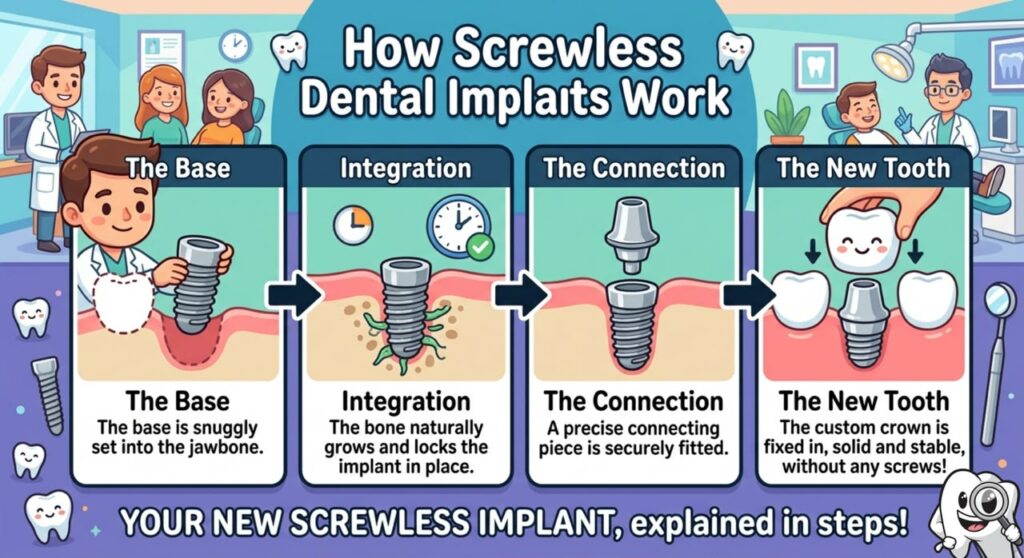
Screwless dental implants do not eliminate the implant itself. The implant post is still surgically placed into the jawbone just like a traditional implant.
The difference lies in how the crown or restoration attaches to the implant.
Instead of using a retaining screw, screwless systems use precision-fit locking mechanisms.
These may include:
Friction-Fit Connections
One of the most common methods is a friction-fit connection.
In this design, the crown and implant components are manufactured with extremely precise tolerances. When connected, they create a tight mechanical seal.
The pressure generated between the two components provides retention without requiring a screw.
This concept is similar to how some machine parts fit together securely without bolts.
Conical Connections
Many screwless systems use a conical or tapered connection.
The abutment and implant have matching angled surfaces. As they are pressed together, they create a strong locking effect.
The design helps distribute chewing forces more evenly throughout the implant system.
Locking Attachment Mechanisms
Some implant manufacturers use proprietary locking systems.
These systems may include:
- Internal retention grooves
- Snap-fit mechanisms
- Specialized engagement surfaces
Each manufacturer has its own approach, but the objective remains the same: secure retention without an external retaining screw.
What Happens During Treatment?
The treatment process is very similar to traditional implant therapy.
Step 1: Implant Placement
The dentist surgically places the titanium implant into the jawbone.
Over the next several months, the implant integrates with the surrounding bone through a process known as osseointegration.
Step 2: Healing Period
The jawbone gradually bonds with the implant surface.
Research has consistently shown implant survival rates above 90% after ten years in properly selected patients.
Step 3: Restoration Fabrication
Once healing is complete, impressions or digital scans are taken.
The dental laboratory creates a custom crown designed specifically for the implant system.
Step 4: Crown Attachment
Instead of securing the crown with a screw, the dentist attaches it using the implant’s screwless retention mechanism.
The result is a stable restoration designed to withstand normal chewing forces.
Benefits of Screwless Dental Implants
Improved Aesthetics
Without screw access holes, dentists can create crowns that more closely resemble natural teeth.
This can be especially useful for front teeth where appearance matters most.
Reduced Risk of Screw Loosening
Since there is no retaining screw, one of the most common technical complications is eliminated.
Simplified Maintenance
Many screwless systems are designed with fewer mechanical components.
This may reduce the number of parts that require long-term monitoring.
Better Force Distribution
Certain conical connection designs distribute biting forces more evenly across the implant structure.
This may contribute to long-term stability.
Increased Patient Comfort
Patients often appreciate restorations that feel more natural and require fewer adjustments over time.
What Does Clinical Evidence Say?
Clinical studies examining modern screwless implant systems have produced encouraging results.
A prospective clinical study published in Clinical Implant Dentistry and Related Research evaluated conical connection implant systems over several years. Researchers reported high implant survival rates and minimal technical complications during follow-up periods.
Another study investigating Morse taper implant connections found strong mechanical stability and low rates of screw-related complications compared with conventional designs.
One frequently cited example involved patients receiving Morse taper implants with friction-fit retention systems. Researchers reported survival rates exceeding 95% after five years, with very few cases requiring restorative maintenance.
While results vary depending on patient health, oral hygiene, and implant system used, current evidence suggests that properly designed screwless implant restorations can perform comparably to traditional systems.
Are There Any Limitations?
Like any dental treatment, screwless implants are not perfect.
Potential limitations include:
Technique Sensitivity
The connection requires extremely accurate manufacturing and placement.
Small inaccuracies can affect the fit and retention of the restoration.
Limited Availability
Not every dental practice offers screwless implant systems.
Availability often depends on the implant brands used by the clinic.
Higher Initial Costs
Some advanced implant systems may involve higher laboratory and component costs.
Case Selection Matters
Certain complex restorations may still benefit from traditional screw-retained designs.
Your dentist will determine which approach best suits your situation.
Who Is a Good Candidate?
Screwless dental implants may be suitable for patients who:
- Have one or more missing teeth
- Have sufficient jawbone density
- Maintain good oral hygiene
- Want a natural-looking restoration
- Prefer a restoration without visible screw access holes
A full examination, including X-rays or 3D imaging, is necessary before determining eligibility.
Information for TRICARE Patients Considering Dental Implants
If you’re a US military family member living in the UK and exploring dental implant treatment options, it’s important to understand how your dental benefits may apply.
Do you accept TRICARE?
Yes. We welcome TRICARE patients and US military families. The Thatch Dental Practice is an official TRICARE Overseas Preferred Provider in the UK and works closely with United Concordia to help eligible patients access dental care.
Will TRICARE cover my dental implant treatment?
Coverage depends on your individual TRICARE plan and the type of treatment required. Before any treatment begins, our team will explain your available options, discuss expected costs, and help you understand any potential out-of-pocket expenses.
For treatments that qualify for coverage, claims are typically submitted directly to TRICARE/United Concordia, meaning most patients do not need to handle the claims process themselves.
Can you help with claims and paperwork?
Yes. Our experienced administrative team manages the claims process on your behalf and can provide any supporting clinical documentation required by TRICARE or United Concordia.
What if I need urgent dental care?
If you are experiencing tooth pain, swelling, or discomfort, please contact us as soon as possible. We will do our best to arrange the earliest appropriate appointment.
Email: patient.coordinator@thethatchdental.co.uk
You can also use the chatbot on our website for quick assistance.
Do you treat children and families?
Yes. We provide dental care for adults and children and are happy to support families with routine check-ups, preventive care, and ongoing oral health needs.
I’m new to the UK. Will the process be difficult?
Not at all. We regularly assist military families who are newly posted to the UK. Our team will guide you through each step, helping ensure smooth access to dental care and support throughout your treatment journey.
Final Thoughts
Screwless dental implants represent an important step forward in implant dentistry. Rather than relying on traditional retaining screws, these systems use precision-engineered connections to securely hold the restoration in place.
For many patients, this approach offers improved aesthetics, reduced risk of screw-related complications, and excellent long-term stability.
Clinical studies continue to show promising outcomes, with survival rates comparable to conventional implant systems when treatment is properly planned and executed.
If you’re considering dental implants and want to learn whether a screwless option is right for you, speak with an experienced implant dentist. A personalized assessment can help determine the most effective solution for restoring your smile and oral function.