A Simple Way to Stop Cavities Before They Start
Problem: Why do cavities keep showing up in back teeth?
You brush twice a day. You try to avoid too much sugar. Still, during dental check-ups, the same issue keeps coming up—cavities in your molars.
This is not unusual. The back teeth (molars and premolars) have deep grooves, called fissures. These grooves are narrow and uneven. A toothbrush often cannot reach inside them properly. Over time, food particles and bacteria settle there. That’s where decay begins.
According to multiple dental health studies, around 80% of cavities in children occur in these grooves of molars. Even adults who maintain regular oral hygiene are not completely safe from this risk.
The result? Fillings, discomfort, and repeated dental visits.
Impact: The hidden cost of “waiting until it hurts”
Many people delay preventive treatments because they don’t feel pain. But cavities don’t start with pain—they start silently.
Once decay progresses, it leads to:
- Tooth structure loss
- Sensitivity while eating or drinking
- Expensive treatments like fillings or root canals
The bigger issue is that dental caries progresses faster in fissures because bacteria are protected inside these grooves.
A case study published in the Journal of Dental Research followed school children over 3 years. The group that did not receive preventive care showed a significantly higher rate of molar decay (over 60%), compared to those who received early intervention.
Now think about this: if a simple step could block those grooves early, most of these cavities could be avoided.
That’s exactly where fissure sealants come in.
Solution: What is a fissure sealant and how does it work?
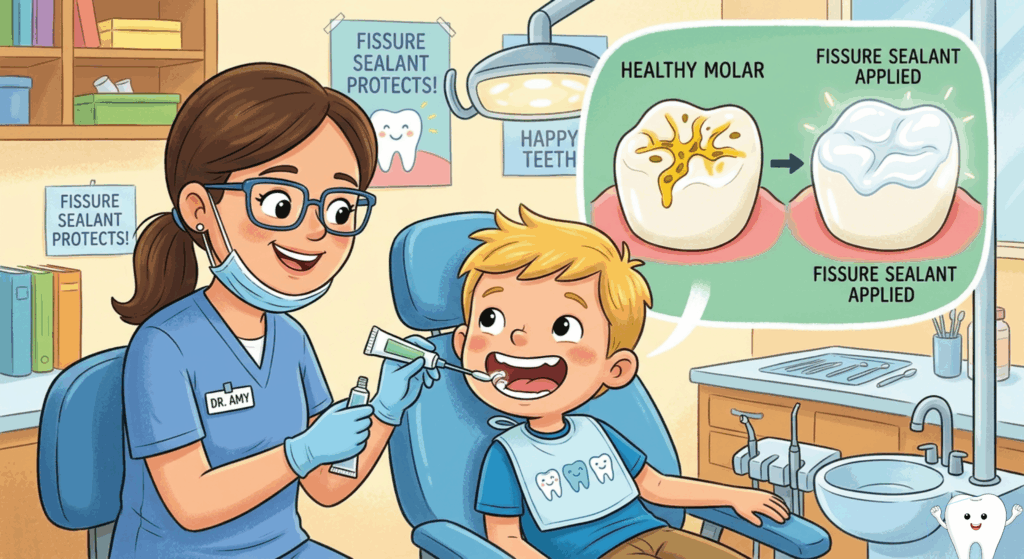
A fissure sealant is a thin protective coating applied to the chewing surfaces of back teeth. It fills and seals the grooves, creating a smooth surface that is easier to clean.
Instead of trying to clean deep fissures daily, the sealant acts as a barrier—stopping food and bacteria from entering in the first place.
The material used is usually a safe dental resin that bonds directly to the tooth.
Here’s how it helps:
- Blocks bacteria from settling in grooves
- Reduces the risk of cavities
- Makes brushing more effective
This is not a treatment for decay. It’s prevention.
How is the procedure done?
One reason fissure sealants are widely recommended is how simple the process is.
There is:
- No drilling
- No injections
- No pain
The steps usually include:
- Cleaning the tooth surface
- Drying and preparing the enamel
- Applying the sealant liquid
- Hardening it using a special light
The whole process takes just a few minutes per tooth.
Patients, especially children, often find it comfortable because it doesn’t involve any invasive steps.
Who should consider fissure sealants?
Fissure sealants are commonly recommended for:
Children (ages 6–14):
This is when permanent molars erupt. These teeth are more vulnerable to decay early on.
Teenagers:
Even if cavities haven’t started yet, sealants can still offer protection.
Adults with deep grooves:
If your molars have not been filled or damaged, sealants can still be applied.
The key factor is not age—it’s risk.
If your dentist notices deep fissures or early signs of plaque buildup in molars, sealants are often suggested.
Real data: Do fissure sealants actually work?
Yes—and the data is consistent.
A report from the Centers for Disease Control and Prevention (CDC) found that:
- Sealants reduce the risk of cavities in molars by up to 80% in the first 2 years
- Continued protection remains strong even after 4 years
Another school-based dental program in the UK tracked children who received sealants versus those who didn’t.
Findings:
- Children with sealants had 50% fewer cavities after 3 years
- The need for fillings dropped significantly in the sealant group
This isn’t a marginal benefit. It’s a measurable reduction in dental problems.
How long do fissure sealants last?
Sealants are not permanent, but they are long-lasting.
Typically, they can last:
- 5 to 10 years with proper care
Dentists check them during routine visits. If they wear down or chip, they can be reapplied easily.
This makes them a low-maintenance preventive option.
Are fissure sealants safe?
Safety is a common concern, especially for children.
Fissure sealants have been used for decades and are considered safe by major dental organizations.
Some sealants may contain trace amounts of Bisphenol A, but studies show that exposure levels are extremely low and within safe limits.
The benefits of preventing decay far outweigh any minimal risk.
Cost vs. savings: Is it worth it?
Let’s look at the numbers.
A single filling costs significantly more than a sealant. If decay progresses, costs increase further with procedures like crowns or root canals.
Sealants, on the other hand:
- Are relatively affordable
- Reduce the need for future treatments
- Save time and discomfort
In preventive dentistry, this is one of the most cost-effective options available.
Common misconceptions about fissure sealants
“I brush well, so I don’t need it.”
Even good brushing cannot reach deep fissures fully.
“It’s only for kids.”
Adults with deep grooves can benefit too.
“It’s a complicated treatment.”
It’s actually one of the simplest procedures in dentistry.
Accessing Preventive Care: What TRICARE Patients Should Know
For families using TRICARE, accessing preventive treatments like fissure sealants is often more straightforward than expected.
Do you accept TRICARE?
Yes. We welcome TRICARE patients and US military families. The Thatch Dental Practice is an official TRICARE Overseas Preferred Provider in the UK, working closely with United Concordia.
Will TRICARE cover all treatments?
Coverage depends on your individual plan and the type of treatment required. Before starting any procedure, your options and expected costs are clearly explained so you can make an informed decision.
For covered treatments, claims are usually submitted directly to TRICARE/United Concordia, and in most cases, you won’t need to pay upfront.
Can you help with paperwork and claims?
Yes. The administrative process is handled for you. Claims are submitted on your behalf, along with any required clinical documentation. You don’t need to manage paperwork yourself.
What if you need urgent care?
If you’re experiencing toothache or discomfort, appointments are arranged as early as possible to address the issue promptly.
Do you see children and families?
Yes. Preventive care, including fissure sealants, is available for both adults and children, making it easier for families to manage oral health together.
New to the UK?
If you’ve recently moved or been posted to the UK, the process is kept simple. You’re guided step-by-step to ensure smooth access to dental care without confusion.
Final takeaway
Cavities in molars are common, but they are not inevitable.
Fissure sealants offer a practical way to stop decay before it starts. They don’t replace brushing or regular check-ups, but they add a strong layer of protection where it matters most.
If you or your child have deep grooves in back teeth, it’s worth asking your dentist about this option.
Because preventing a problem is always easier—and cheaper—than fixing it later.