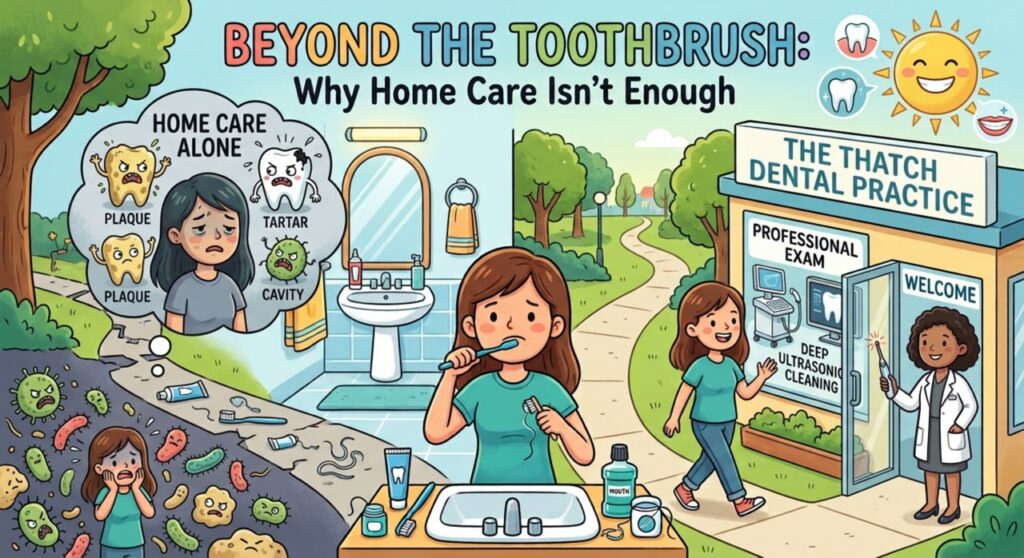
Brushing your teeth twice a day is one of the most important things you can do for your oral health. Add fluoride toothpaste, flossing or interdental cleaning, and cutting down on sugary foods, and you are already doing a lot to protect your teeth.
But there is one common mistake: assuming that a good home-care routine means you no longer need professional dental care.
Your toothbrush can remove plaque. It can help prevent tooth decay and gum disease. But it cannot remove everything, see what is happening underneath your gums, take an X-ray, or identify a small problem before it becomes painful.
That is why looking after your teeth at home and visiting your dentist are not competing approaches. They work together.
The Problem: Your Toothbrush Can’t Do Everything
Think about what happens inside your mouth every day.
You eat, drink, talk and breathe. Bacteria naturally build up on your teeth, forming a sticky film called plaque. If plaque is not removed properly, it can contribute to tooth decay and gum disease.
The NHS recommends brushing twice a day for around two minutes with fluoride toothpaste. Adults should generally use toothpaste containing at least 1,350 parts per million fluoride. Cleaning between your teeth every day is also important because a toothbrush cannot effectively reach every surface.
So why isn’t this enough?
Because some problems develop in places you cannot easily see or clean.
Plaque can harden into calculus, commonly called tartar. Once it has hardened, brushing and flossing cannot remove it. A dentist or dental hygienist needs professional instruments to remove it.
This is where many people get caught out.
You may look in the mirror and think your teeth look clean. You may have no pain. You may brush every morning and night.
Yet tartar could still be sitting around your gumline.
The Impact: Dental Problems Often Don’t Hurt at First
Pain is not always a warning sign that appears early.
This is one of the biggest reasons relying only on how your teeth feel can be risky.
Early gum disease, known as gingivitis, can cause red, swollen or bleeding gums. If plaque and tartar remain around the teeth, gum disease can progress and affect the tissues and bone supporting your teeth. In more advanced cases, teeth can become loose or may eventually need to be removed.
Tooth decay can also develop without obvious symptoms.
The CDC reports that around 1 in 5 adults aged 20–64 has at least one untreated cavity in the United States.
That figure is useful because it highlights an important point: people can have dental problems while continuing their normal daily routine.
You can brush.
You can eat normally.
You can go to work.
And you can still have a cavity that needs treatment.
A real-world data lesson
Published oral-health surveillance data show that untreated dental problems remain common even in populations where brushing and dental care are widely available.
The CDC also reports that more than 40% of adults have experienced mouth pain within the previous year, while more than 80% of people will have had at least one cavity by age 34.
These numbers do not mean home care is failing.
They show the opposite: home care is essential, but it is only one part of prevention.
What Can a Dentist Detect That You Can’t?
A dental appointment is not simply about checking whether your teeth look clean.
A dentist can assess areas that are difficult for you to examine at home.
1. Early tooth decay
Small areas of decay may not cause pain. Your dentist can examine your teeth for early signs and, where appropriate, use X-rays to look at areas that cannot be seen directly.
Finding a problem early may mean simpler treatment.
Waiting until the tooth hurts can mean the problem has progressed further.
2. Gum disease
You might notice bleeding when brushing and assume that you are brushing too hard.
Sometimes, however, bleeding gums are a sign of gum disease.
Your dentist or hygienist can assess your gums and identify signs that may not be obvious when you look in the mirror.
The NHS recommends regular dental check-ups and professional advice for maintaining healthy gums. For people with gum disease, treatment can include professional cleaning and, in more serious cases, deeper cleaning beneath the gums.
3. Tartar build-up
Once plaque turns into tartar, your toothbrush cannot simply brush it away.
Professional cleaning is needed to remove it.
This is particularly important around the gumline and in areas that are difficult to reach with a toothbrush.
4. Cracks, worn teeth and other problems
Not every dental problem is caused by poor brushing.
Teeth can crack, wear down, become sensitive or develop problems around existing fillings, crowns and other dental work.
A professional examination gives your dental team the opportunity to identify these issues before they become bigger problems.
The Solution: Combine Home Care With Professional Dental Care
The answer isn’t to stop worrying about brushing because you have regular dental appointments.
It is the opposite.
Your daily routine should support your professional dental care.
Start with the basics.
Brush twice a day
Use fluoride toothpaste and spend around two minutes cleaning your teeth. Pay attention to all surfaces rather than simply brushing the teeth you can see when you smile.
Clean between your teeth
Floss or use interdental brushes every day, depending on what works best for your mouth.
Cleaning between your teeth helps remove plaque from areas your toothbrush cannot reach.
Watch your sugar intake
Frequent exposure to sugary foods and drinks gives bacteria more opportunities to produce acids that damage teeth. Reducing sugary snacks and drinks can help lower your risk of tooth decay.
Don’t ignore bleeding gums
If your gums regularly bleed when you brush or clean between your teeth, don’t simply accept it as normal.
It is worth discussing with your dentist.
Keep your dental appointments
Your dentist can recommend how often you need a check-up based on your individual oral-health needs. There is no single schedule that is perfect for everyone.
Regular examinations allow problems to be identified before they become emergencies.
Why This Matters for Patients in Bury St Edmunds and Beyond
Whether you live in Bury St Edmunds, Mildenhall, Lakenheath, Brandon, Thetford or Newmarket, the principle is the same: good oral health requires more than a toothbrush.
Home care gives you daily protection.
Professional dental care gives you something your toothbrush cannot provide: assessment, diagnosis, professional cleaning and treatment when necessary.
The goal isn’t to replace your home routine with dental appointments.
The goal is to make the two work together.
Final Thoughts
Your toothbrush is one of your best tools for protecting your teeth, but it is not a dental examination.
Brushing cannot remove hardened tartar. Flossing cannot diagnose a cavity. Mouthwash cannot replace professional assessment. And waiting for pain is not a reliable way to know whether your mouth is healthy.
The best approach is simple:
Brush twice a day. Clean between your teeth. Watch your diet. Don’t ignore warning signs. And keep your regular dental appointments.
Good oral health is built at home, but it is maintained through a combination of daily care and professional care.
So, go beyond the toothbrush.
Your future smile may depend on it.