
Losing a tooth can affect more than just your smile. It can make chewing difficult, change the way you speak and sometimes affect your confidence. Dental implants are a popular option for replacing missing teeth, but one question many patients ask before starting treatment is: tooth implant procedure, how long does it take?
The answer depends on several factors, including your jawbone condition, gum health, the number of implants required and whether additional procedures such as bone grafting are needed.
For some patients, the process takes around three to six months after implant placement. More complex cases can take six to twelve months or longer. Understanding each stage can help you prepare and make an informed decision.
1. Problem: Why Does the Dental Implant Procedure Take So Long?
When you lose a tooth, you naturally want a replacement as soon as possible. You might expect a dental implant to be fitted in one appointment, just like a filling or a crown.
However, dental implants work differently.
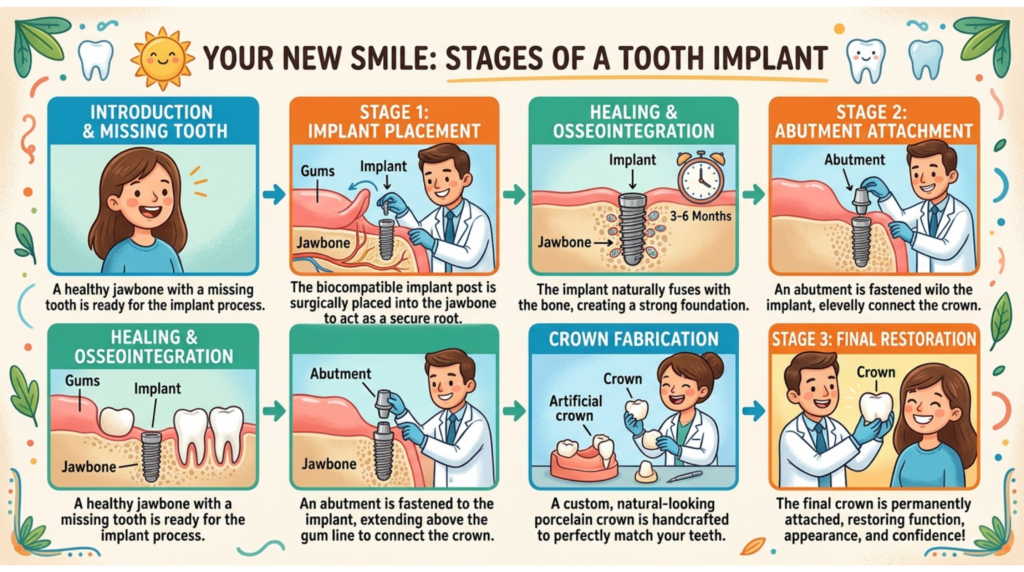
A dental implant is a small titanium post that is placed into the jawbone to act as an artificial tooth root. Once inserted, it needs time to bond with the surrounding bone. This biological process is known as osseointegration.
Unlike other tooth replacement options, an implant needs to become stable within your jawbone before your dentist can attach the final replacement tooth.
This is why the treatment involves several stages rather than a single visit.
According to Cambridge University Hospitals, the healing period for dental implants is usually around three to six months, although some patients may require longer.
The actual implant placement appointment may take approximately 30 minutes for a single implant, but the complete treatment takes considerably longer.
2. Impact: What Happens If You Rush the Dental Implant Procedure?
Waiting several months for a replacement tooth can feel frustrating, especially if the missing tooth is visible when you smile.
However, rushing the treatment can create unnecessary problems.
Your implant needs sufficient time to integrate with the jawbone. If the implant is placed under too much pressure before it becomes stable, there is a risk that it may not heal successfully.
Other factors can also affect the treatment timeline:
Insufficient jawbone: Patients with bone loss may require bone grafting before implant placement.
Gum disease: Existing gum infections may need treatment before implant surgery.
Smoking: Smoking can interfere with healing and increase the risk of implant complications.
Poor oral hygiene: Inadequate cleaning can increase the risk of infection and inflammation around the implant.
Complex treatment: Replacing several teeth can involve additional planning, appointments and healing periods.
The important thing to remember is that successful implant treatment is not simply about how quickly the replacement tooth can be fitted. It is about achieving a stable result that can function properly over time.
3. Solution: How Long Does Each Stage of the Tooth Implant Procedure Take?
Let’s look at the complete dental implant process, from your first consultation to receiving your permanent replacement tooth.
Stage 1: Initial Consultation and Assessment (1–2 Appointments)
Your treatment begins with a dental examination.
Your dentist will assess your teeth, gums and jawbone to determine whether you are suitable for dental implants.
This stage may include:
Dental X-rays.
A 3D CBCT scan, if clinically required.
Assessment of jawbone density and volume.
Checking your gum health.
Reviewing your medical and dental history.
The dentist will also discuss the treatment plan, expected timeline and available replacement options.
Stage 2: Bone Grafting (If Required)
Not everyone needs bone grafting before receiving a dental implant.
However, if your jawbone is too thin or weak to support the implant, your dentist may recommend a bone graft.
This procedure involves adding bone material to the affected area to improve the available bone support.
Bone grafting can add approximately four to six months to the treatment timeline, depending on the procedure and healing response.
According to Guy’s and St Thomas’ NHS Foundation Trust, bone grafting may extend implant treatment by four to six months.
Stage 3: Dental Implant Placement (Around 30–90 Minutes for a Single Implant)
Once your dentist confirms that your jawbone is suitable, the implant placement procedure can begin.
The procedure is usually performed under local anaesthetic, meaning the treatment area is numbed while you remain awake.
The dentist will:
Make a small incision in the gum.
Carefully prepare a space in the jawbone.
Place the titanium implant into the bone.
Position the gum tissue and close the area with stitches.
Cambridge University Hospitals states that placing a single dental implant usually takes around 30 minutes. More complicated procedures or multiple implants can take longer.
Stage 4: Healing and Osseointegration (3–6 Months)
This is usually the longest part of the dental implant procedure.
After placement, the implant needs time to integrate with your jawbone. During this period, new bone forms around the implant, helping it become stable.
The gum tissue generally heals within one to two weeks, but the underlying bone takes considerably longer.
Your dentist will monitor the healing process and decide when the implant is ready to support the replacement tooth.
Some patients may receive a temporary tooth during this period, depending on their treatment plan.
Stage 5: Fitting the Abutment and Permanent Crown (Several Weeks)
Once the implant has integrated successfully, the next step is attaching the abutment.
An abutment is a small connector that joins the implant to the replacement tooth.
Your dentist will take impressions or digital scans to help create a crown that fits comfortably and matches your surrounding teeth.
After the crown has been prepared, it is attached to the implant.
Your new tooth is now ready to function as part of your smile.
4. Real Dental Implant Case Study: How Long Can Treatment Actually Take?
A published case study from Dental Smiles Takeley provides a useful example of how treatment duration can vary.
The patient had missing front teeth and required a more complex implant procedure involving bone grafting.
The dental team carried out careful planning and used 3D imaging to assess the available bone.
Because additional bone grafting was required, the complete treatment took approximately seven months.
The patient was also provided with a temporary replacement during the treatment period.
This case demonstrates why dental implants cannot always be completed within a few weeks. The healing process and individual treatment requirements play a major role in determining the final timeline.
It is important to remember that this is one published clinical example, not a guaranteed treatment duration for every patient.
5. How Can You Help Your Dental Implant Heal Faster?
Although you cannot force your jawbone to heal more quickly, you can support the recovery process by following your dentist’s instructions.
Here are some useful tips:
Avoid smoking during the healing period.
Brush your teeth carefully and maintain good oral hygiene.
Follow your dentist’s advice about cleaning around the surgical area.
Avoid putting unnecessary pressure on the implant.
Attend all follow-up appointments.
Eat the recommended foods during the initial recovery period.
Contact your dentist if you experience increasing pain, swelling or other unusual symptoms.
Good aftercare is an important part of protecting your investment in dental implant treatment.
6. Frequently Asked Questions About Dental Implant Treatment
Q1. How long does a tooth implant procedure take from start to finish?
A straightforward dental implant procedure may take around three to six months after implant placement. However, the complete process can take six to twelve months or longer if bone grafting or additional treatment is required.
Q2. Is dental implant surgery painful?
The procedure is usually performed under local anaesthetic, so you should not feel pain during the implant placement. Some discomfort, swelling and bruising can occur afterwards.
Q3. Can I get a dental implant in one day?
Some carefully selected patients may qualify for immediate implant placement or a temporary tooth on the same day. However, this does not mean the implant has fully healed. The permanent restoration may still need to wait until the implant has integrated with the bone.
Q4. How long does it take for a dental implant to heal?
The gum usually heals within one to two weeks, while the implant generally needs around three to six months to integrate with the jawbone.
Dental Implant Treatment and TRICARE: Information for US Military Families
If you are a US military family living in the UK, understanding how to access dental treatment and manage TRICARE benefits is important. At The Thatch Dental Practice, we welcome TRICARE patients and US military families, helping them access dental care with clear guidance and support.
The Thatch Dental Practice is an official TRICARE Overseas Preferred Provider in the UK, working closely with United Concordia. Our team can help you understand the treatment process, explain the available options and assist with the necessary administration.
If you are considering dental implants or need advice about another dental concern, here are some common questions from TRICARE patients.
Frequently Asked Questions for TRICARE Patients
Do you accept TRICARE?
Yes. We welcome TRICARE patients and US military families. The Thatch Dental Practice is an official TRICARE Overseas Preferred Provider in the UK, working closely with United Concordia to help patients access dental care.
Will TRICARE cover my dental implant treatment?
TRICARE coverage depends on your individual eligibility, benefits and the type of treatment required. Dental implant treatment should not be assumed to be covered automatically.
Before starting treatment, we will explain your options and discuss the expected costs so you can make an informed decision. Where applicable, claims are submitted to TRICARE/United Concordia, and eligible patients generally do not need to pay the practice upfront for covered treatment.
Can you help with TRICARE paperwork and claims?
Absolutely. Our experienced team will assist with the administrative process, including submitting claims on your behalf and providing any required clinical notes or supporting documentation.
Our aim is to make accessing dental care as straightforward as possible, without you having to manage complicated paperwork yourself.
I have toothache. Can I get an urgent appointment?
Yes. If you are experiencing toothache, dental pain or discomfort, please contact our practice. We will do our best to arrange the earliest appropriate appointment based on availability.
You can reach our patient coordination team at:
Email: patient.coordinator@thethatchdental.co.uk
Alternatively, use the chatbot on our website for quick assistance.
Do you provide dental care for children and families?
Yes. We provide dental care for adults and children, including routine check-ups, preventive treatments and ongoing oral health support. We are happy to help military families maintain their dental health while living in the UK.
I’m new to the UK. Will accessing dental care be complicated?
Not at all. We regularly welcome patients who are new to the UK or have recently been posted to the area.
Our team will guide you through the process step by step, explain the available treatment options and help you access dental care with as little inconvenience as possible.
Whether you need a routine examination, help with toothache or advice about replacing missing teeth, we are here to help.
Final Thoughts: Is Waiting for a Dental Implant Worth It?
A dental implant is not an instant replacement for a missing tooth. It is a carefully planned treatment that requires time, patience and proper aftercare.
While a straightforward case may progress within three to six months after implant placement, more complicated treatments can take considerably longer.
The best approach is to arrange a professional dental assessment, understand your individual treatment requirements and follow the recommended healing schedule.
Don’t let uncertainty about treatment time stop you from exploring your options. A discussion with a qualified dental professional can help you understand what to expect and whether dental implants are suitable for your smile.