Imagine this: It is 1 a.m. You are tired, ready to sleep, and suddenly a sharp pain starts in one of your teeth. You change your sleeping position, drink some water, and try to ignore it. But the pain keeps coming back.
Sound familiar?
Tooth pain at night can make it difficult to sleep, concentrate, or even relax. When your dentist is unavailable, you need practical steps that can help you manage the pain until morning.
The good news? You can try several simple home remedies to reduce toothache discomfort. However, remember that these methods provide temporary relief and cannot repair a cavity or cure a dental infection.
Let’s explore how to stop tooth pain fast at home at night, what you should avoid, and when you need professional dental care.
1. Problem: Why Does Tooth Pain Get Worse at Night?
Tooth pain can happen for several reasons, including cavities, gum inflammation, cracked teeth, damaged fillings, or a dental abscess.
Sometimes, food gets trapped between your teeth and irritates the surrounding gums. In other cases, tooth decay reaches the sensitive inner part of the tooth, causing sharp or throbbing pain.
But why does the pain seem worse at night?
When you lie down, changes in blood flow and pressure around inflamed tissues may contribute to discomfort. At night, there are also fewer distractions, so you may notice the pain more clearly.
According to the World Health Organization (WHO), oral diseases affect nearly 3.7 billion people worldwide. Untreated tooth decay is among the most common health conditions globally. These figures show why dental pain is a widespread problem rather than an unusual experience.
Source: WHO Oral Health Fact Sheet, 2025.
The important point is this: If your tooth hurts repeatedly, your body may be signaling an underlying dental problem. Ignoring it can allow the problem to get worse.
2. Impact: What Happens When You Ignore Tooth Pain?
A toothache might begin as mild sensitivity when drinking cold water. A few days later, it may develop into persistent pain that interrupts your sleep.
You might reach for a home remedy, feel better for an hour, and assume the problem has disappeared. Then the pain returns.
This cycle can be frustrating.
Untreated decay can progress deeper into a tooth. In some cases, bacteria can cause an infection around the tooth’s root, resulting in swelling, severe pain, and the need for urgent treatment.
Nighttime tooth pain can also affect your sleep, leaving you tired and less able to concentrate the next day.
That is why the goal should be twofold: reduce the pain safely tonight and arrange dental treatment to address its cause.
3. Solution: 8 Ways to Help Stop Tooth Pain at Home at Night
Method 1: Rinse Your Mouth With Warm Salt Water
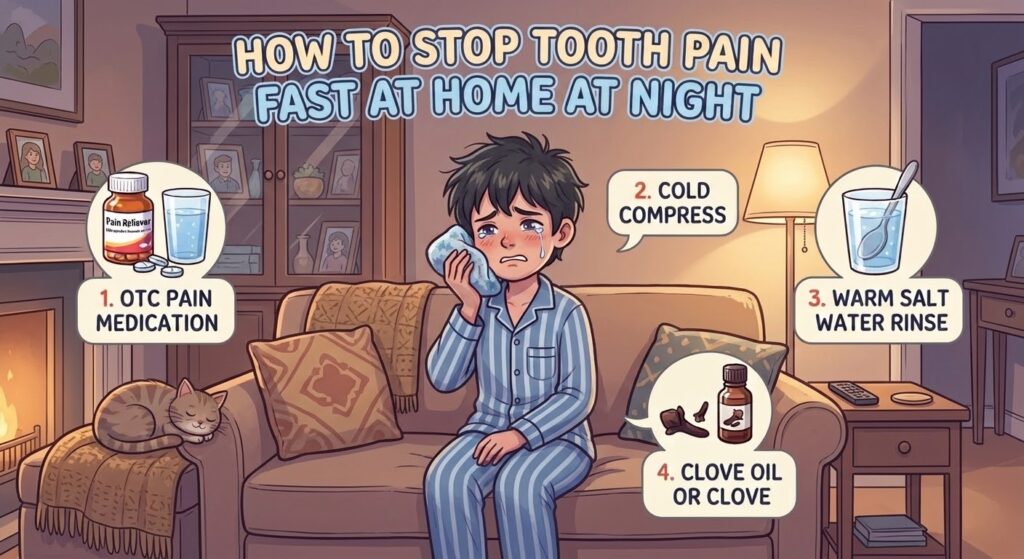
A warm saltwater rinse is a simple first step when a tooth starts hurting.
Saltwater can help clear loose food particles and keep the mouth clean. It may also soothe irritated gums, although it will not cure a cavity or dental abscess.
How to do it:
Take one glass of warm water.
Mix in half a teaspoon of salt.
Swish the solution gently around your mouth.
Spit it out instead of swallowing it.
Repeat as needed if it feels comfortable.
Make sure the water is warm, not hot. Children who may swallow the solution should not use this method.
Method 2: Use a Cold Compress
If your toothache comes with cheek swelling or follows an injury, a cold compress may help reduce discomfort.
Cold can temporarily numb the area and reduce swelling.
How to do it:
Wrap an ice pack in a clean towel.
Hold it against the outside of your cheek for about 15–20 minutes.
Remove it and allow your skin to return to its normal temperature before repeating.
Never place ice directly on the tooth or against bare skin.
If swelling is increasing, do not rely on a cold compress instead of seeking dental care.
Method 3: Keep Your Head Elevated While Sleeping
Does your tooth start throbbing as soon as you lie down?
Try resting with your head slightly elevated using an extra pillow or a supportive wedge.
This position may make nighttime discomfort more manageable for some people. It will not treat the underlying cause, but it is a simple adjustment worth trying.
Avoid putting pressure on the painful side of your face if that makes the pain worse.
Method 4: Carefully Clean Between Your Teeth
Sometimes, the cause of discomfort is something surprisingly simple: food trapped between two teeth.
A small piece of food can irritate the gums and make the area feel sore.
Try gently flossing around the affected tooth to remove any trapped debris. Rinse your mouth with warm water afterward.
Do not force the floss into your gums, poke the tooth with sharp objects, or continue flossing if it causes significant pain.
If the pain continues after cleaning, the cause may be something other than trapped food.
Method 5: Avoid Very Hot, Cold, and Sweet Foods
If your tooth is sensitive, certain foods and drinks can trigger another wave of pain.
For tonight, avoid ice-cold beverages, steaming-hot tea, sugary snacks, and sweet drinks. Choose soft foods at a comfortable temperature instead.
Options include plain yogurt, soft rice, scrambled eggs, or lukewarm soup.
Chew on the opposite side of your mouth and drink water regularly.
These small changes can help prevent unnecessary irritation while you arrange dental care.
Method 6: Brush Gently With Fluoride Toothpaste
When your tooth hurts, you may feel tempted to avoid brushing altogether. However, keeping your mouth clean remains important.
Use a soft-bristled toothbrush and fluoride toothpaste. Brush gently, paying attention to the surrounding teeth and gumline without pressing hard on the painful area.
Avoid aggressive brushing or repeatedly touching the tooth to check whether it still hurts.
Good oral hygiene helps control plaque, but brushing cannot repair an established cavity.
Method 7: Avoid Unproven Home Remedies
You may have heard that garlic, alcohol, undiluted essential oils, or other household substances can stop tooth pain instantly.
Be careful.
Applying harsh substances directly to your gums can irritate or burn the tissues. Essential oils can be harmful if swallowed, and alcohol is not a treatment for dental infection.
Clove oil is also not risk-free and can irritate oral tissues if used incorrectly.
Stick to safer measures such as saltwater rinses, cold compresses when appropriate, gentle cleaning, and suitable pain relief.
Do not start leftover antibiotics or someone else’s prescription medication. Antibiotics are not appropriate for every toothache, and a dentist needs to determine whether they are necessary.
Method 8: Arrange a Dental Appointment as Soon as Possible
This is the step that makes the biggest difference in the long run.
If your toothache continues into the morning, contact a dentist. Seek an earlier appointment if the pain is severe, persistent, or getting worse.
A dentist can examine the tooth, identify the cause, and recommend the correct treatment. Depending on the problem, this may involve a filling, treatment of the tooth’s pulp, drainage of an abscess, or another procedure.
Temporary relief should never become a reason to postpone necessary treatment.
4. A Realistic Case Example: Why Temporary Relief Is Not a Cure
Consider a hypothetical example based on common dental symptoms.
An adult develops tooth sensitivity after drinking cold water. Later that night, the discomfort becomes a throbbing ache. They rinse with warm salt water, take an appropriate pain reliever according to its label, and sleep with their head elevated.
The pain becomes manageable, so they decide not to book a dental appointment.
Two days later, the pain returns, this time with gum swelling.
This example illustrates a common risk: reducing pain does not necessarily mean the underlying problem has healed.
It is not a documented patient case, and it does not predict what will happen to every person with toothache. However, the underlying concern is supported by dental guidance: tooth decay and infections may require professional treatment even when symptoms temporarily improve.
The WHO’s 2025 oral health fact sheet estimates that nearly 3.7 billion people worldwide are affected by oral diseases. That is a strong reminder that prevention, early assessment, and access to dental care matter.
5. When Is Tooth Pain a Dental Emergency?
Some symptoms require urgent attention rather than another home remedy.
Seek emergency medical care immediately if you experience:
Difficulty breathing or swallowing.
Swelling around the eye or neck.
Mouth or neck swelling that makes speaking or swallowing difficult.
Contact a dentist urgently if you have:
Facial or jaw swelling.
Fever alongside tooth pain.
Pus, a foul taste, or signs of infection.
Severe or rapidly worsening pain.
Pain when biting or difficulty opening your mouth.
Do not wait until morning if you have emergency warning signs.
The NHS also advises seeing a dentist when toothache lasts longer than two days or does not improve with painkillers.
Conclusion: Get Relief Tonight, Protect Your Teeth Tomorrow
Tooth pain at night can turn an ordinary evening into a difficult one. Fortunately, a warm saltwater rinse, a cold compress when appropriate, gentle cleaning, an elevated sleeping position, and suitable pain relief may help you manage the discomfort temporarily.
But remember the most important rule: home remedies can help control toothache, but they cannot reliably cure the problem causing it.
Pay attention to your symptoms, avoid risky remedies, and arrange dental care as soon as possible. If swelling, fever, or other warning signs appear, seek urgent help.
You do not have to spend another night guessing what to do. Take safe steps now, and let a dental professional help you address the real cause of the pain.