For some people, going to the dentist is more than an appointment. The thought of sitting in the dental chair can cause sweating, a racing heart, shaking, nausea or an overwhelming urge to cancel.
If this sounds familiar, you are not alone. Dental fear and anxiety affect a significant number of adults. A systematic review involving 72,577 adults found that around 15.3% experienced dental fear and anxiety, while about 3.3% experienced severe dental fear.
The good news is that dental phobia can be managed. You do not have to force yourself to suddenly become comfortable with dental treatment. The right approach is usually gradual, planned and based around giving you more control.
Problem: Why Does Dental Phobia Feel So Difficult?
Dental phobia is an intense fear of dental treatment. It can develop for many reasons.
You may have experienced painful dental treatment in the past. Perhaps you had an unpleasant experience as a child, felt that a dentist did not listen to you, or became frightened by the sound of dental equipment.
For someone else, the fear may be connected to injections, drilling, gagging, the dental chair, the feeling of being unable to speak during treatment or simply not knowing what is going to happen.
Sometimes there is no single obvious reason.
The important thing is that your fear is real. Telling yourself to “just relax” usually does not solve the problem.
Dental anxiety can also create a cycle:
Fear → avoiding the dentist → dental problems worsen → more complicated treatment → greater fear → more avoidance.
This cycle can continue for years.
You might ignore a small cavity because you are afraid of having it treated. Eventually, the tooth may become painful or infected. What could have been a relatively simple appointment may then require more extensive treatment.
That is why overcoming dental phobia is not simply about feeling more comfortable. It can also help you protect your long-term oral health.
Impact: What Happens When You Keep Avoiding the Dentist?
Avoidance can feel like a solution in the short term.
You cancel the appointment. You feel relieved. The immediate anxiety disappears.
But the underlying problem has not disappeared.
If you have tooth decay, gum disease, a cracked tooth or another dental problem, avoiding treatment does not make it go away. In some cases, delaying care can allow the condition to become more difficult to manage.
Dental phobia can also affect your everyday life.
You may constantly worry about your teeth. You might avoid smiling in photographs, hesitate to eat certain foods or feel embarrassed about the condition of your mouth. Some people only seek help when pain becomes severe.
Research supports the idea that dental fear can affect patterns of dental attendance and oral health.
And there is another important point: you do not need to wait until you feel completely fearless before visiting a dentist.
The goal is not necessarily to eliminate every nervous feeling. The goal is to make dental care manageable enough that you can receive the treatment you need.
Solution: How to Overcome Dental Phobia
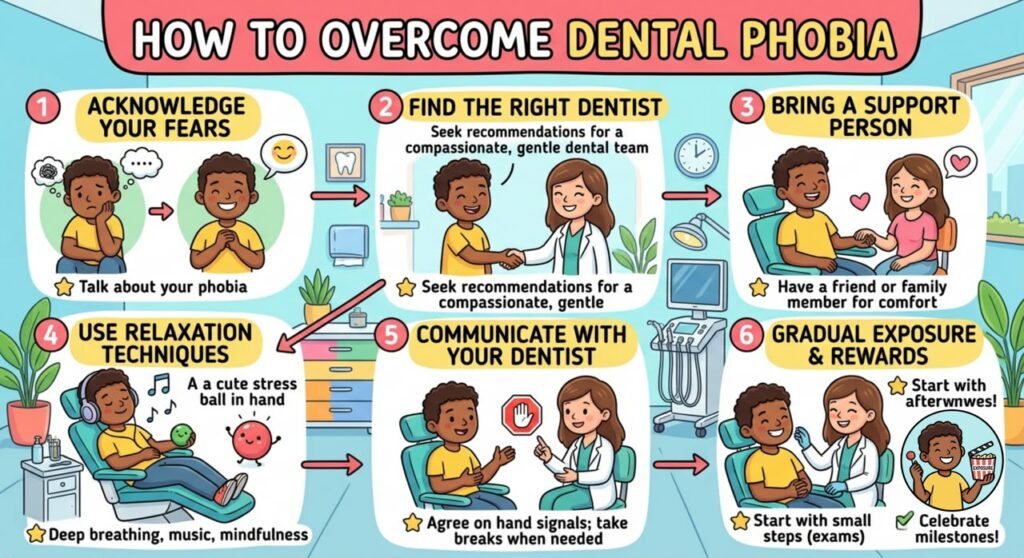
1. Tell the dental team that you are frightened
This is one of the most important first steps.
When booking your appointment, simply say:
“I have a strong fear of dental treatment and I am very anxious about coming in.”
You do not need to be embarrassed.
A dental team that regularly works with anxious patients can adapt the appointment around your needs. NHS England guidance specifically recommends approaches such as rapport building, longer appointments, treatment staging and communication strategies for people experiencing dental anxiety.
The dentist cannot help manage a fear they do not know about.
2. Start with a simple consultation
If the idea of having treatment immediately is too much, ask whether your first appointment can simply be a consultation.
You can discuss your concerns, allow the dentist to examine your mouth and talk through possible treatment options.
There does not always have to be a procedure on the first visit.
Starting slowly can help your brain learn that entering a dental practice does not automatically mean something painful is going to happen.
3. Agree on a stop signal
One of the biggest fears for anxious patients is feeling trapped.
A simple stop signal can change this.
For example, you might agree that raising your left hand means:
“Please stop.”
Knowing that you can ask the dentist to pause can give you a greater sense of control.
NHS England’s dental anxiety guidance highlights enhancing patient control as one of the behavioural techniques that can help manage anxiety.
4. Break treatment into smaller steps
You do not necessarily have to complete everything in one appointment.
Treatment can sometimes be staged according to your level of anxiety and clinical needs.
For example:
Visit 1: Talk about your concerns and examination
Visit 2: Discuss treatment and practise coping techniques
Visit 3: Begin a simple procedure
Later visits: Continue treatment gradually
Longer appointments can also be useful for some people with moderate anxiety because they allow the dental team more time to use anxiety-management techniques.
5. Learn simple breathing techniques
Anxiety can cause rapid breathing, muscle tension and a racing heart.
Before and during an appointment, try slow, controlled breathing.
For example, breathe in gently through your nose and slowly breathe out through your mouth. Concentrate on making the exhale longer and more relaxed.
The purpose is not to magically remove your fear. It is to prevent anxiety from continually escalating.
You can practise this at home before your appointment so that it feels familiar when you are sitting in the dental chair.
6. Consider cognitive behavioural therapy (CBT)
For significant dental phobia, simply having a friendly dentist may not be enough.
Cognitive behavioural therapy can help you identify the thoughts, emotions and behaviours that maintain your fear.
For example:
Thought: “The treatment will be unbearable.”
Feeling: Panic and fear.
Behaviour: Cancel the appointment.
CBT can help you challenge unhelpful thoughts and gradually change avoidance behaviour.
A 2024 systematic review and meta-analysis of randomised controlled trials found moderate-certainty evidence supporting CBT for reducing long-term dental anxiety, while evidence also supported psychotherapy and CBT specifically for dental phobia.
NHS England also recognises CBT as an evidence-based option for longer-term management of dental phobia.
7. Ask whether sedation could help
For some patients, behavioural techniques alone may not be enough.
Conscious sedation can be considered after an appropriate assessment. Depending on the patient and treatment, options can include inhalation sedation or intravenous sedation.
Sedation does not mean you are put under a general anaesthetic. With conscious sedation, the aim is to reduce anxiety while maintaining communication and appropriate protective reflexes.
However, sedation is not automatically the best choice for everyone. Your dentist should assess your health, level of anxiety and proposed treatment before recommending an option.
8. Do not be afraid to change dentist
The relationship between you and your dental team matters.
If you feel dismissed, rushed or embarrassed when you explain your anxiety, it may be difficult to make progress.
Look for a dentist who listens, explains treatment clearly and gives you time to ask questions.
A supportive environment can make a major difference.
What Does the Evidence Say?
There is good reason to believe that dental fear can improve.
A meta-analysis of behavioural interventions reviewed 38 studies involving treatment for dental fear. Most studies reported reductions in self-reported anxiety, and long-term follow-up data suggested that many patients continued attending dental appointments after treatment.
More recent evidence also supports the use of psychological approaches, particularly CBT, for persistent dental anxiety and phobia.
So, if you have avoided the dentist for years, that does not mean you are stuck with the fear forever.
A Simple First Step
If dental treatment currently feels impossible, do not start by thinking about everything that might happen.
Think about the next small step.
Call the dental practice.
Explain your fear.
Ask for an anxiety-friendly consultation.
Tell the dentist what you are worried about.
Agree on a stop signal.
Then take things one stage at a time.
You do not have to walk into the dental practice feeling completely confident. You only need enough courage to take the first step.
Final Thoughts
Dental phobia is common, but it is treatable.
You can use communication, gradual exposure, breathing techniques, behavioural approaches, CBT and, where appropriate, conscious sedation to make dental care more manageable.
Most importantly, do not feel ashamed of your fear.
A good dental team will take your concerns seriously and work with you rather than expecting you to simply “get over it.”
If you have been avoiding the dentist because of fear, start with a conversation. Your first appointment does not have to be about fixing everything. It can simply be about understanding what you need to feel safe enough to move forward.