You wake up with a dull ache in your tooth. At first, you think it will go away. Then you start thinking about what could be wrong. Is it a cavity? Will I need a root canal? What if the dentist says I need an extraction?
Within minutes, the pain seems worse.
This is not simply “being worried.” Toothache and anxiety can be connected, and research shows that anxiety can influence how people experience pain. At the same time, tooth pain can create fear and stress, especially when someone is already nervous about dental treatment.
So, is the pain real? Yes. Can anxiety make it feel worse? It can. And can avoiding the dentist because of anxiety make the original dental problem worse? Absolutely.
The Problem: Toothache Can Trigger More Than Physical Pain
A toothache usually has a physical cause. Common causes include tooth decay, a cracked tooth, gum disease, dental infection, an abscess, worn fillings or problems with a wisdom tooth.
But pain does not happen in isolation. Your brain constantly processes information about pain, danger and stress.
When you are anxious, you may become more focused on physical sensations. A small twinge that you might normally ignore can suddenly feel important. You may keep checking the tooth with your tongue, avoid chewing on that side and constantly think about whether the pain is getting worse.
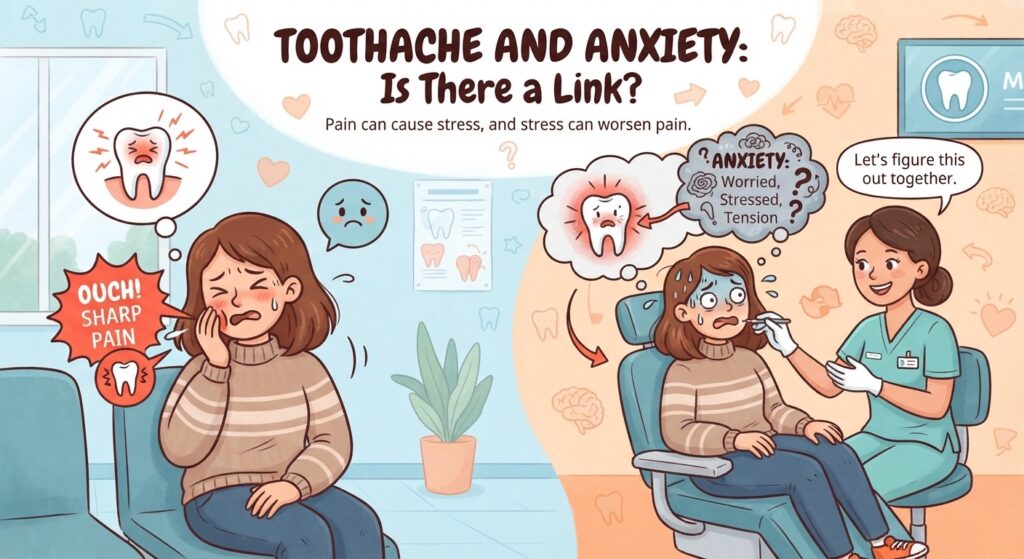
That attention can create a cycle:
Toothache → worry → increased attention to pain → more fear → stronger perception of pain → more worry.
Research supports a connection between anxiety and oral pain. A 2024 systematic review looked at 13 cross-sectional studies and found a positive relationship between orofacial pain and anxiety. The strength of the relationship varied from weak to moderate, with several studies identifying anxiety as a possible risk factor for orofacial pain.
This does not mean anxiety is the cause of every toothache. It means psychological factors can influence how pain is experienced.
The Impact: Anxiety Can Make a Dental Problem Harder to Deal With
The biggest problem is not always the anxiety itself. It is what anxiety makes you do next.
You may tell yourself:
“I will wait another few days.”
Then another week passes.
The pain might temporarily settle, giving you the impression that the problem has disappeared. But dental problems do not always heal simply because the pain stops.
For example, tooth decay can progress deeper into a tooth. An infection can spread into surrounding tissues. Gum disease can continue damaging the structures supporting the teeth.
Dental anxiety can therefore create a difficult cycle. You experience pain, become frightened about treatment, avoid the dentist, and give the dental problem more time to develop. When you finally seek help, you may need more treatment than you would have needed earlier.
There is also evidence that dental anxiety is common. A systematic review and meta-analysis involving 72,577 adults estimated that dental fear and anxiety affected around 15.3% of adults worldwide, while high dental fear affected 12.4% and severe dental fear affected 3.3%.
That means millions of people may be dealing with some level of dental fear.
And if you are one of them, you are not unusual.
What Does the Research Say About Anxiety and Pain?
Researchers have specifically looked at whether anxiety affects pain during dental treatment.
A 2023 systematic review examined four studies involving 471 patients undergoing endodontic treatment, such as root canal procedures. Two studies found a positive association between anxiety and pain before treatment, while two of three studies examining anxiety and pain during treatment found a significant positive association. The researchers concluded that dental anxiety can be associated with pain before and during endodontic treatment, although they also rated the overall certainty of the evidence as low or very low.
This is important because it gives us a more balanced answer.
Anxiety does not mean your toothache is “in your head.”
Instead, anxiety can affect your expectation and perception of pain.
Think about it this way. If you expect something to hurt badly, your brain may become more alert to every sensation. That can make the experience more difficult.
This is why telling someone with toothache to “just relax” is not a useful solution. Their pain needs to be investigated, and their anxiety needs to be taken seriously.
A Real Research Example
Consider the evidence from the systematic review above.
Researchers looked at hundreds of patients receiving endodontic treatment and found that anxiety was associated with pain in several of the included studies. This does not prove that anxiety caused the pain in every patient. Instead, it shows that anxiety and pain can interact during dental care.
This is one reason modern dental care increasingly considers both sides of the problem: treating the physical cause of pain and helping patients feel more comfortable during treatment.
The good news is that anxiety can be managed.
A 2023 systematic review and meta-analysis of 20 randomised controlled trials, involving 969 participants in intervention groups and 892 in control groups, found that interventions designed to manage dental fear and anxiety reduced anxiety levels more than control approaches.
More recent research has also found that behavioural approaches can help. A 2025 meta-analysis involving 940 participants reported that behavioural therapy was more effective than inhalational sedation in reducing dental anxiety before treatment, although the researchers noted variation between studies.
The Solution: Break the Toothache-Anxiety Cycle
The first step is simple: do not assume that anxiety is causing your toothache.
If you have persistent, severe or recurring tooth pain, arrange a dental examination.
A dentist can determine whether the problem is caused by decay, an infection, a cracked tooth, gum disease, a wisdom tooth or another condition.
If you are anxious about visiting the dentist, tell the dental team before your appointment.
You can say:
“I am very anxious about dental treatment and I am worried about the pain.”
That information matters.
A dental team can explain what is happening before treatment starts, discuss pain-control options and agree on ways to make the appointment easier. Depending on the situation, approaches may include clear communication, breaks during treatment, behavioural techniques and, where appropriate, sedation.
You can also take practical steps before your appointment:
- Write down your symptoms and when they started.
- Tell the dentist what makes you anxious.
- Ask the dentist to explain the procedure before starting.
- Agree on a signal if you need a break.
- Avoid searching for frightening dental stories online.
- Do not ignore worsening tooth pain simply because you are nervous.
When Should Toothache Be Treated Urgently?
Do not wait for a routine appointment if toothache is accompanied by significant facial swelling, swelling around the eye or neck, difficulty breathing or swallowing, or other signs of a serious infection.
Severe or worsening dental pain also deserves prompt professional assessment.
Painkillers may temporarily reduce symptoms, but they do not remove the underlying cause of most dental problems.
Final Thoughts
So, is there a link between toothache and anxiety? Yes.
The relationship can work in both directions. Toothache can create fear and stress, while anxiety can increase pain sensitivity, influence pain expectations and make dental treatment feel more difficult.
But there is an important message to remember: anxiety does not make your toothache imaginary.
If your tooth hurts, find out why.
And if you are anxious about seeing a dentist, say so. You do not need to hide your fear or wait until the pain becomes unbearable.
Getting help early can mean dealing with a smaller dental problem, rather than allowing pain and anxiety to feed each other for weeks or months.
Your first appointment does not have to be about fixing everything at once. It can simply be about understanding what is causing the pain and deciding what to do next.