Getting a dental crown is one of the most common ways to restore a damaged tooth. Whether it is due to decay, a cracked tooth, or after a root canal, millions of people receive crowns every year. But if you have spent time reading online discussions, you may have come across a worrying question: Can dental crowns cause cancer?
It is an understandable concern. Anything placed inside your body for years naturally raises questions about long-term safety. Add internet rumors and mixed opinions, and confusion grows quickly.
The short answer is this: there is no strong scientific evidence proving that properly made dental crowns cause cancer. However, concerns about certain materials, metal allergies, and older dental products have led people to ask important questions.
In this article, we will break down what research says, look at existing case studies, and explain when you should be concerned and when you should not.
The Problem: Why Are People Worried About Dental Crowns?
The concern around dental crowns and cancer mainly comes from three areas:
- Metal exposure from crowns
- Materials used in older dental restorations
- Online misinformation linking dental work to serious diseases
Dental crowns are usually made from materials like:
- Porcelain
- Ceramic
- Zirconia
- Metal alloys
- Porcelain fused to metal (PFM)
Some people worry that metals used in crowns may release harmful substances into the body over time. Others are concerned about whether long-term exposure could trigger oral cancer or other health conditions.
These concerns became more common after discussions around heavy metals in dentistry, especially mercury in fillings and certain metal alloys.
The problem is that online forums often mix facts with fear. A single personal story can sound convincing, even when there is no medical proof behind it.
Impact the Concern: What Happens If You Ignore Questions About Dental Materials?
Ignoring concerns completely is not the answer either.
While dental crowns themselves are not considered cancer-causing, poor-quality dental work or badly fitted crowns can create oral health problems.
For example:
A crown that does not fit properly may irritate surrounding gum tissue for years. Chronic irritation in the mouth is something dentists monitor carefully because long-term inflammation has been linked with oral tissue changes.
Some patients also react to certain metals. Nickel-based alloys, for instance, may trigger allergic reactions in sensitive individuals.
A 2019 review published in dental biomaterial research discussed how some dental metals may release very small amounts of ions due to corrosion in saliva. However, researchers also noted that the levels are generally considered too low to directly cause cancer in healthy individuals.
Still, uncertainty can create anxiety.
You may wonder:
- “What if my crown contains harmful metals?”
- “Could old dental work increase cancer risk?”
- “Should I remove my crown just to stay safe?”
These are fair questions. But making decisions based on fear instead of evidence can lead to unnecessary dental procedures and extra costs.
The Facts: What Does Science Say?
Here is what current research tells us.
No Direct Proof That Dental Crowns Cause Cancer
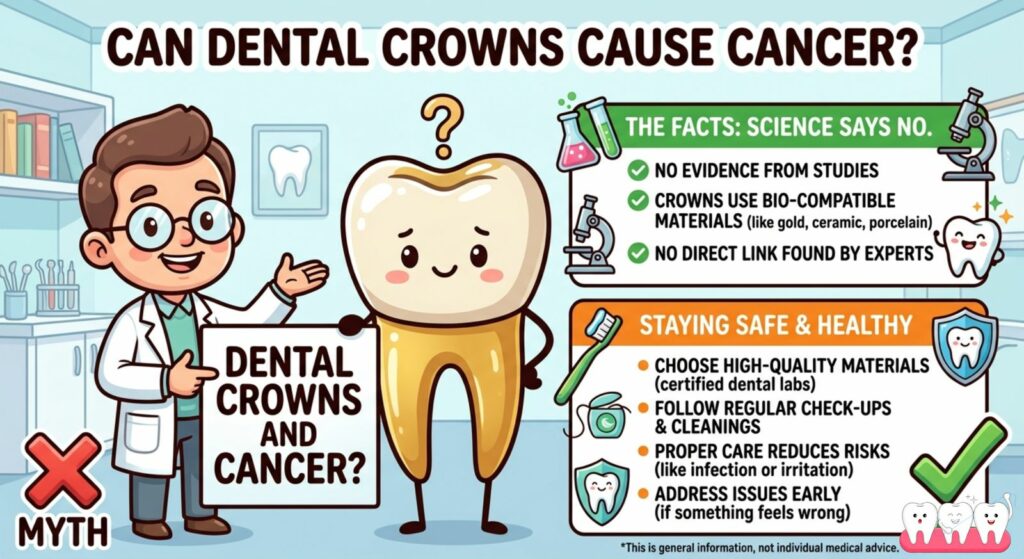
There is no established scientific evidence showing that dental crowns directly cause cancer.
Researchers have studied dental materials for decades because they remain inside the mouth for long periods.
Most crown materials go through biocompatibility testing before approval. This means they are checked to ensure they do not create harmful effects inside the body.
According to dental safety research, ceramic and zirconia crowns are considered highly biocompatible and generally safe for long-term use.
Metal-based crowns are also widely used, although some people prefer metal-free options because of allergies or personal concerns.
Oral Cancer Is Usually Linked to Different Risk Factors
When doctors study oral cancer cases, the strongest causes are typically:
- Tobacco use
- Heavy alcohol consumption
- HPV infection
- Poor oral hygiene
- Long-term sun exposure (for lip cancer)
- Family history
Dental crowns are not listed as a major risk factor.
A large review in oral pathology research found that lifestyle factors play a much stronger role in oral cancer development than dental restorations.
Existing Case Study: Chronic Irritation vs Crown Material
Some confusion comes from case reports involving chronic irritation.
For example, there have been isolated reports where rough or broken dental restorations repeatedly irritated oral tissue over many years. In a few cases, patients later developed suspicious lesions.
But researchers could not prove that the crown material itself caused cancer.
Instead, experts pointed toward long-term irritation combined with other risk factors, such as smoking or untreated oral disease.
This distinction matters.
A poorly maintained crown may contribute to irritation, but that does not mean the crown itself is cancer-causing.
Are Metal Crowns Dangerous?
Metal crowns often raise the biggest concerns.
Older crowns sometimes contained alloys with nickel, chromium, or other metals.
Here is what research generally says:
Gold Crowns
Gold-based crowns have been used for decades and are considered stable and safe. They rarely cause allergic reactions.
Porcelain-Fused-to-Metal Crowns (PFM)
These crowns combine a metal base with porcelain.
For most patients, they are safe. However, people with metal sensitivities may experience irritation or allergic reactions.
Nickel-Based Crowns
Nickel allergy is relatively common.
A patient with metal sensitivity may notice:
- Gum irritation
- Redness
- Swelling
- Discomfort near the crown
This is usually an allergic response, not cancer.
If symptoms persist, a dentist may recommend replacing the restoration with ceramic or zirconia.
Zirconia and Ceramic Crowns
These are often promoted as “metal-free” options.
Zirconia crowns are widely viewed as one of the most biocompatible choices available today because they resist corrosion and do not contain metal alloys.
Signs You Should Not Ignore
Even though crowns are not known to cause cancer, regular dental monitoring still matters.
Contact a dentist if you notice:
- A sore in the mouth that does not heal after two weeks
- Bleeding around a crown
- Persistent pain
- Gum swelling
- White or red patches in the mouth
- A loose or damaged crown causing irritation
Most of the time, these symptoms are linked to infection, irritation, or gum disease.
But persistent changes should always be checked.
Early detection makes a major difference in oral health outcomes.
The Solution: How to Stay Safe With Dental Crowns
If you already have a crown, there is no reason to panic.
Instead, focus on practical steps that actually protect your health.
1. Ask About Crown Materials
If you are getting a new crown, ask your dentist what material is being used.
If you have metal sensitivities, zirconia or ceramic may be worth discussing.
2. Schedule Regular Dental Checkups
A dentist can monitor your crown and surrounding tissue for signs of irritation or wear.
Small problems are easier to fix early.
3. Keep Your Mouth Healthy
Daily brushing, flossing, and cleanings help reduce inflammation and infection risk.
Healthy gums support long-lasting restorations.
4. Avoid High-Risk Habits
Smoking and heavy alcohol use are far more strongly linked to oral cancer than dental crowns.
Reducing these risks matters more than worrying about approved dental materials.
Final Thoughts
So, can dental crowns cause cancer?
Based on current evidence, the answer is no—there is no strong scientific proof that dental crowns directly cause cancer.
Most concerns come from misunderstandings about dental materials or isolated reports involving irritation rather than the crown itself.
That said, not all crowns are equal. Poorly fitted restorations, allergic reactions, or untreated oral problems should never be ignored.
The best approach is simple: choose quality dental care, know your crown material, and stay consistent with checkups.
If something feels unusual around your crown, get it checked. Peace of mind often starts with a professional opinion, not internet rumors.
FAQs
Can an old dental crown become toxic?
Most crowns remain safe for many years. However, damaged or poorly fitting crowns may need replacement.
Are zirconia crowns safer than metal crowns?
Zirconia crowns are considered highly biocompatible and metal-free, making them a popular option for patients with sensitivities.
Can irritation from a crown lead to cancer?
Long-term irritation should be checked, but irritation alone does not automatically cause cancer. Other major risk factors usually play a bigger role.
Should I replace my metal crown to avoid cancer?
There is no evidence suggesting replacement is necessary solely because of cancer concerns. Speak with your dentist if you have allergies, discomfort, or concerns about materials.