Problem: Tooth Decay Starts Early and Often Goes Unnoticed
Tooth decay is still one of the most common health problems worldwide, especially in children and teenagers. According to the World Health Organization, around 60–90% of school-aged children globally experience dental cavities. In the UK, NHS data shows that tooth decay remains the leading cause of hospital admissions for children aged 6–10.
The problem usually begins in the back teeth.
Molars and premolars have deep grooves on their chewing surfaces. These grooves trap food and bacteria. Even with regular brushing, it is difficult for toothbrush bristles to reach these narrow areas. Over time, plaque builds up, acids form, and enamel starts breaking down.
Parents often believe that brushing twice a day is enough. Many adults assume they are doing everything right. But cavities do not always cause pain at the start. By the time discomfort appears, damage has already occurred.
This is where most decay quietly begins—out of sight and untreated.
Impact: Untreated Grooves Turn Into Costly Dental Problems
When food and bacteria stay trapped in tooth grooves, decay progresses faster than expected. Studies show that the chewing surfaces of molars account for nearly 80% of cavities in children, even though these surfaces represent a much smaller portion of the tooth.
Once decay starts, treatment becomes unavoidable.
A small cavity can turn into a filling. A deeper cavity may need root canal treatment. In severe cases, extraction becomes the only option. For children, this can mean missed school days, dental anxiety, and hospital visits under general anaesthesia. For adults, it often means higher treatment costs and long-term oral health issues.
The financial impact is also significant. NHS reports indicate that treating preventable tooth decay costs the UK healthcare system hundreds of millions of pounds every year. Most of these cases could have been avoided with early preventive care.
The frustrating part?
Tooth decay in grooves is largely preventable. Yet many people are never told about simple preventive options that could protect their teeth for years.
Solution: Dental Sealants Offer Proven Protection
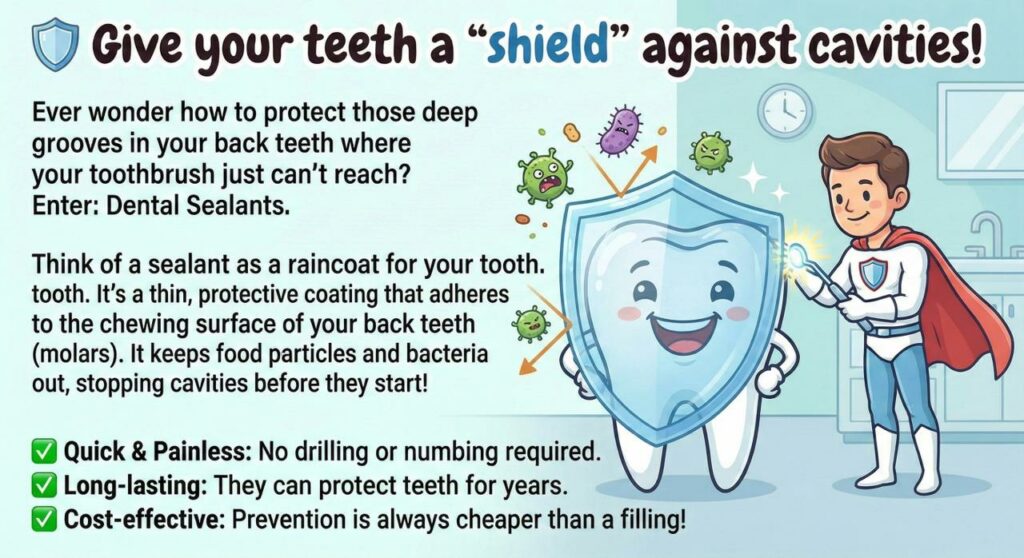
Dental sealants are thin protective coatings applied to the chewing surfaces of back teeth. They work by sealing deep grooves and pits where food and bacteria usually collect. Once sealed, these areas become smooth and easier to clean.
The process is quick, painless, and non-invasive.
No drilling is involved. No tooth structure is removed. The tooth is cleaned, dried, and the sealant material is painted onto the surface. A special light hardens the material within seconds. The entire procedure usually takes just a few minutes per tooth.
What Does the Evidence Say?
Dental sealants are not a new concept. They have been studied for decades, and the results are consistent.
A Cochrane Review, one of the most trusted sources for healthcare evidence, found that sealants reduce the risk of decay in molars by up to 80% in the first two years after application. Even after four years, sealed teeth showed significantly fewer cavities compared to unsealed teeth.
Another long-term study published in the Journal of Dental Research followed children with sealed molars over nine years. The study reported that sealed teeth had 65% fewer cavities than unsealed teeth, even when regular brushing habits were similar.
These findings confirm one thing: sealants work.
Who Should Consider Dental Sealants?
Dental sealants are most commonly recommended for children and teenagers, but they are not limited to younger age groups.
Children and Teenagers
Permanent molars usually erupt between the ages of 6 and 12. This is when teeth are most vulnerable. Applying sealants soon after eruption offers maximum protection during high-risk years.
Public Health England supports sealant use as part of preventive dental care for children, especially those at higher risk of decay.
Adults
Adults with deep grooves, early signs of enamel wear, or a history of cavities can also benefit. Sealants can be applied to adult teeth as long as there is no existing decay.
Patients with High Decay Risk
People with dry mouth, orthodontic appliances, or difficulty maintaining oral hygiene may benefit more from sealants than brushing alone.
How Long Do Dental Sealants Last?
Dental sealants are durable but not permanent.
Most sealants last 5 to 10 years, depending on biting forces, oral habits, and regular dental check-ups. Dentists routinely check sealants during examinations and can repair or replace them if needed.
Even partially retained sealants still offer protection, as long as some coverage remains in the grooves.
The cost of maintaining sealants is far lower than treating cavities later.
Are Dental Sealants Safe?
Yes. Dental sealants have been widely used and studied for over 40 years.
Concerns have occasionally been raised about trace BPA exposure. However, multiple studies, including reviews by the American Dental Association and Public Health England, confirm that exposure from sealants is extremely low and well below safety limits.
The preventive benefits clearly outweigh any minimal risk.
Dental Sealants vs Fillings: Prevention Beats Repair
A filling repairs damage after decay has occurred. A sealant prevents that damage from happening in the first place.
Once a tooth is filled, it will always require maintenance. Fillings can wear out, crack, or need replacement. Each replacement removes more natural tooth structure.
Sealants protect the original tooth surface and delay or eliminate the need for future treatment.
From a long-term perspective, prevention always wins.
Dental Sealants and TRICARE: Common Questions from Military Families
Preventive treatments like dental sealants are especially valuable for families who want to avoid unexpected dental problems and treatment delays. For patients covered under TRICARE, a few practical questions often come up before booking an appointment.
Do you accept TRICARE?
Yes. We welcome TRICARE patients and US military families.
The Thatch Dental Practice is an official TRICARE Overseas Preferred Provider in the UK, working closely with United Concordia to support eligible patients.
Will TRICARE cover all of my treatment?
TRICARE coverage depends on your individual plan and the type of treatment required. Before starting any treatment, we clearly explain your options and discuss expected costs so you can make an informed decision.
For treatments that are covered, claims are submitted directly to TRICARE/United Concordia. In most cases, you do not need to pay us directly.
Can you help with paperwork and claims?
Yes. Our experienced team manages the administrative process for you. We submit claims on your behalf and provide any required clinical notes or documentation, so you do not need to handle paperwork yourself.
I have toothache — can I be seen urgently?
Yes. If you are experiencing pain or discomfort, please contact us and we will do our best to offer the earliest appropriate appointment.
You can email patient.coordinator@thethatchdental.co.uk or use the chatbot on our website for quick assistance.
Do you see children and families?
Yes. We provide dental care for both adults and children. This includes routine check-ups, preventive care such as dental sealants, and ongoing oral health support for the whole family.
I’m new to the UK — will the process be complicated?
Not at all. We regularly support patients who are new to the UK or newly posted to the area. Our team guides you step by step and helps ensure smooth and timely access to dental care.
Final Thoughts: Small Step, Big Impact
Dental sealants are one of the most effective preventive tools in modern dentistry. They are quick to apply, affordable, and backed by strong scientific evidence.
Yet many people still miss out on this protection simply because they are unaware of it.
If cavities keep appearing despite good brushing habits, or if a child is getting permanent teeth, sealants should be part of the conversation. Preventive care today can save years of treatment later.
Healthy teeth are not just about fixing problems. They are about stopping problems before they start—and dental sealants do exactly that.